

Misc. Tech
Latest Andru Edwards Videos
AI Routed a 16-Year-Old Up Crown Mountain. He Ended Up on a Climb Called the Widowmaker.

Posted by Andru Edwards Categories: GPS, Misc. Tech, Artificial Intelligence,

A 16-year-old set off from Grouse Mountain at 8 a.m. on Saturday with a route up Crown Mountain that an AI tool had planned for him. The route was supposed to go up a gully. It put him into steep, technical rock-climbing terrain instead, and by mid-afternoon he was stopped at the base of a cliff with no way up and no safe way down. North Shore Rescue got the call just before 3:30 p.m.
The climbing route he had ended up on is called the Widowmaker. "It turns out that this hiker had somehow got far off the Crown hiking route (we are unclear exactly how/where) and became stranded on a climbing route known as the 'Widowmaker', at the base of its final headwall," the volunteer team said. Two rescue technicians were lowered from a helicopter, hoisted him into the aircraft, and flew him to a base near Cleveland Dam. The operation finished shortly before 6:30 p.m.
Read More  | North Shore News
Advertisement
The Department of War Will Pay Up to $75 Million to Turn an EV Battery Line Into Drone Cells. Only $22 Million Is Funded.
Posted by Andru Edwards Categories: Misc. Tech, Transportation,

An American factory built to make batteries for electric cars is about to start making them for military drones instead. Amprius Technologies landed a grant of up to $75 million from the US Department of War to do it. Only about $22 million of that has actually been obligated.
Amprius makes silicon anode lithium-ion cells, the kind pitched for years at EVs and electric aviation because they pack more energy into less weight. On September 28 the company said it will retrofit an existing US production line, currently run by what it calls a major South Korean manufacturer, to build 12 million of its cells a year for small and midsize drones. The target is early 2028.
Oracle Says Its New Mexico Stargate Site Is On Schedule. It Filed to Delay the Rent Anyway.
Posted by Andru Edwards Categories: Corporate News, Misc. Tech, Artificial Intelligence,

Oracle says Project Jupiter, its 2.45-gigawatt AI data center in southern New Mexico, remains on schedule. It has also sent its landlord a force majeure notice, which is the paperwork you file when you think you might not be able to hold up your end.
The notice went to Stack Infrastructure, a Blue Owl Capital unit developing the campus in Doña Ana County. Oracle is the tenant, and per Bloomberg's reporting it cannot walk away from the lease and is not trying to. What the notice does is preserve an argument. If the site misses its 2028 target because the power did not show up, Oracle wants the right to push back when the rent clock starts.
Samsung Pushed a Test Build to Korean Fridges Two Days Before Chuseok
Posted by Andru Edwards Categories: Corporate News, Smart Home, Misc. Tech,

Your refrigerator does not have a reboot ritual. You don't sit down with a coffee and watch a progress bar crawl across the door panel. It runs for a decade, and the only time you think about it is when the ice maker jams. On the afternoon of September 22, a batch of Samsung owners in South Korea found out that deal had quietly changed.
Samsung has confirmed that a test version of a refrigerator software update went out through SmartThings by mistake instead of the finished release. Units froze partway through. The panel sat on an update message and then went dark. Interior lights stayed off, the door's auto-open feature stopped responding, the SmartThings app listed the fridge as offline, and unplugging it and plugging it back in did nothing. What it stopped doing, above all, was refrigerate.
Click to continue reading Samsung Pushed a Test Build to Korean Fridges Two Days Before Chuseok
Verbatim’s AA, AAA and 9V Batteries Charge From a USB-C Cable, No Charger Needed
Posted by Andru Edwards Categories: Accessories, USB, Misc. Tech,
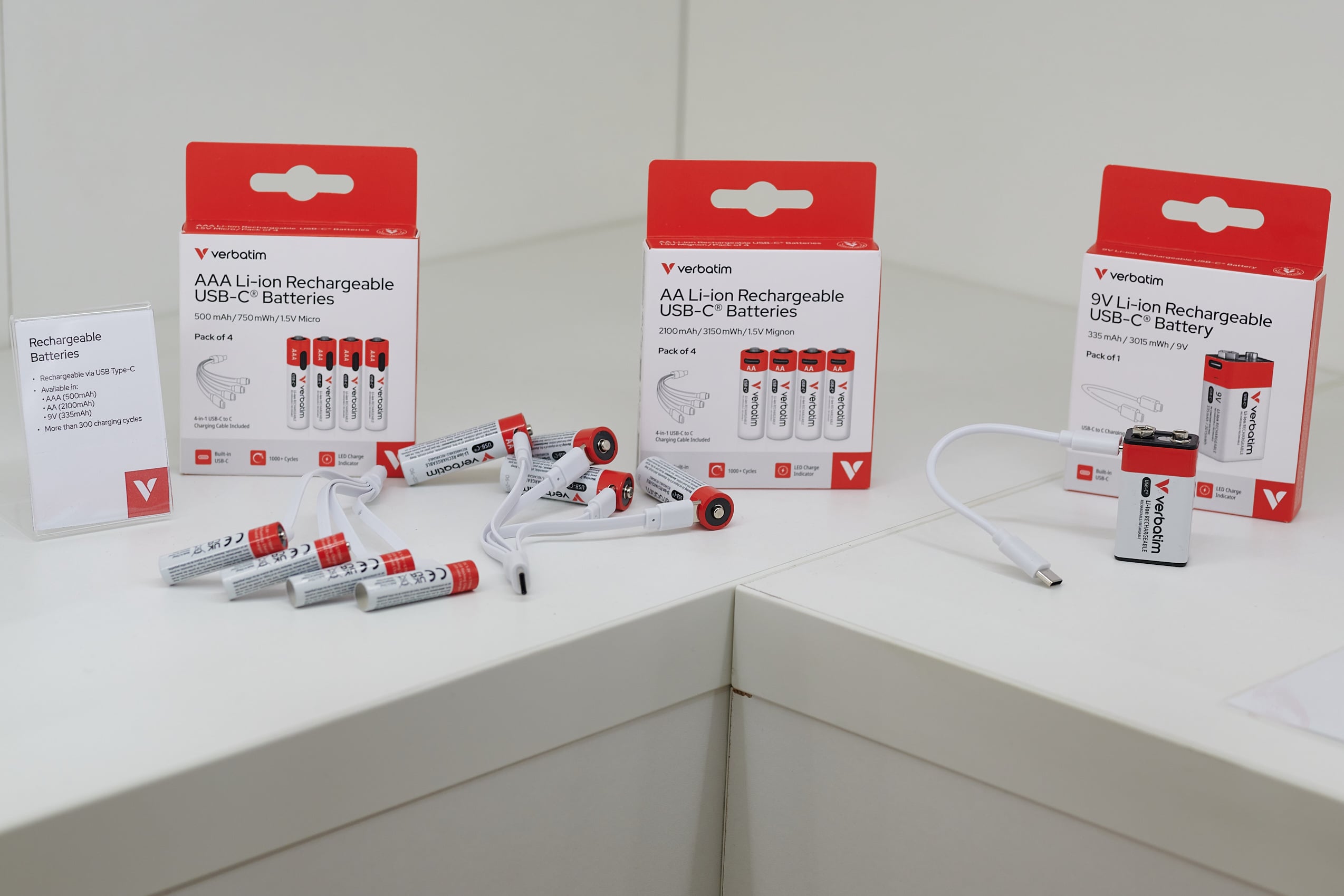
Somewhere in your house is a drawer with loose AA batteries rolling around in it, and you have no idea which ones still work. Verbatim's answer, shown off at IFA in Berlin, is to move the charging port onto the battery itself. Plug the cell into the same cable that charges your phone and wait.
The company brought AA, AAA and 9V lithium-ion cells, all of which charge over USB-C with no dedicated charger involved. The AA and AAA packs come with a multi-connector charging cable so you can top up several at once. The AAA is worth a second look, because its USB-C port runs lengthwise along the cell instead of sitting across the end, which is about the only sane way to fit a port that size on something that skinny.
CD Revenue Jumped 58.6% in Six Months, and K-Pop Fans Get Most of the Credit
Posted by Andru Edwards Categories: Features, Misc. Tech, Music,

Nobody was supposed to be buying CDs in 2026. US CD revenue hit $171.1 million in the first half of the year, up 58.6% from $107.9 million in the same six months of 2025, according to the RIAA's mid-year report. Shipments rose 45.7% to 17.5 million discs. Labels moved $312.4 million worth of CDs in all of 2025, so the format cleared more than half of last year's entire haul before July.
That is a real number and a small one. Physical formats account for 12% of US recorded music revenue. CDs on their own are under 3%. Streaming took 82% of the money, and streaming's six-month increase of $219 million was bigger than the entire CD business. Keep the scale in mind. What changed is who is buying, and that has a specific answer.
Xiaomi’s Smart Band 11 Tracks Sleep HRV for About $43
Posted by Andru Edwards Categories: Wearables, Misc. Tech,

An Oura Ring 4 costs $349, and then it asks for a monthly membership on top. Xiaomi's Smart Band 11, now official in China, costs 289 yuan. That is about $43, and it also wants to tell you what your heart rate variability did while you were asleep.
Xiaomi is not claiming the Band 11 matches a $349 ring sensor for sensor, and nobody should assume it does until reviewers spend a few weeks with one. But the price is low enough that the usual question about wrist trackers, whether the data is worth what you paid for it, mostly answers itself.
Click to continue reading Xiaomi’s Smart Band 11 Tracks Sleep HRV for About $43
153 Million License Scans Are for Sale, and the Sellers Say They Still Have Access
Posted by Andru Edwards Categories: Internet, Misc. Tech,

The last time you handed your driver's license to a rental car counter, or a hotel front desk, or the guy working the door at a dispensary, somebody ran it through a scanner. You probably never learned the name of the company behind that scanner. You never signed up with them, either.
A dark web store called Nexus is selling those scans. Its catalog claims 153 million driver's licenses covering people in the United States and Canada. Brian Krebs broke the story Wednesday at Krebs on Security, and he verified it against himself. He found a record holding six image files of his own license, timestamped to a trip he took in June 2025. Other people he reached out to found their own records too.
Dyson Put a Camera Inside a $500 Toothbrush
Posted by Andru Edwards Categories: Cameras, Smart Home, Misc. Tech,

Dyson spent six years building a toothbrush that can see inside your mouth. The CameraJet is up for pre-order now at $499.99 in Ceramic Ultra Blue and Ceramic Pink, and it ships September 8. It brushes, flosses and rinses in one pass. The seeing part is the whole pitch. A camera under the brush head finds the gaps between your teeth and fires water at them, so you never have to aim.
That is either the most Dyson product ever made or five hundred dollars for a toothbrush. Both are true.
Click to continue reading Dyson Put a Camera Inside a $500 Toothbrush
VW’s first electric California camper skips the kitchen and the pop-top
Posted by Andru Edwards Categories: Misc. Tech, Transportation,

The camper van fantasy usually falls apart at the sink. You picture waking up at a trailhead with the doors thrown open, and then you remember the plumbing, the gas bottle, and the cabinetry you haul around all year and use four weekends of it.
Volkswagen's answer is to leave most of that out. The ID. California Cruise, shown today at the Caravan Salon in Düsseldorf, is the first fully electric van to wear the California badge, and it's built on the ID. Buzz Pro. You get a bed for two, blackout blinds on every window, two camping chairs, a table, and a 2,000-watt socket. You don't get a kitchen, and going by what VW has announced, you don't get a pop-top roof either.
Click to continue reading VW’s first electric California camper skips the kitchen and the pop-top