

Saturday September 5, 2026 4:52 pm
Verbatim’s AA, AAA and 9V Batteries Charge From a USB-C Cable, No Charger Needed

Posted by Andru Edwards Categories: Accessories, USB, Misc. Tech
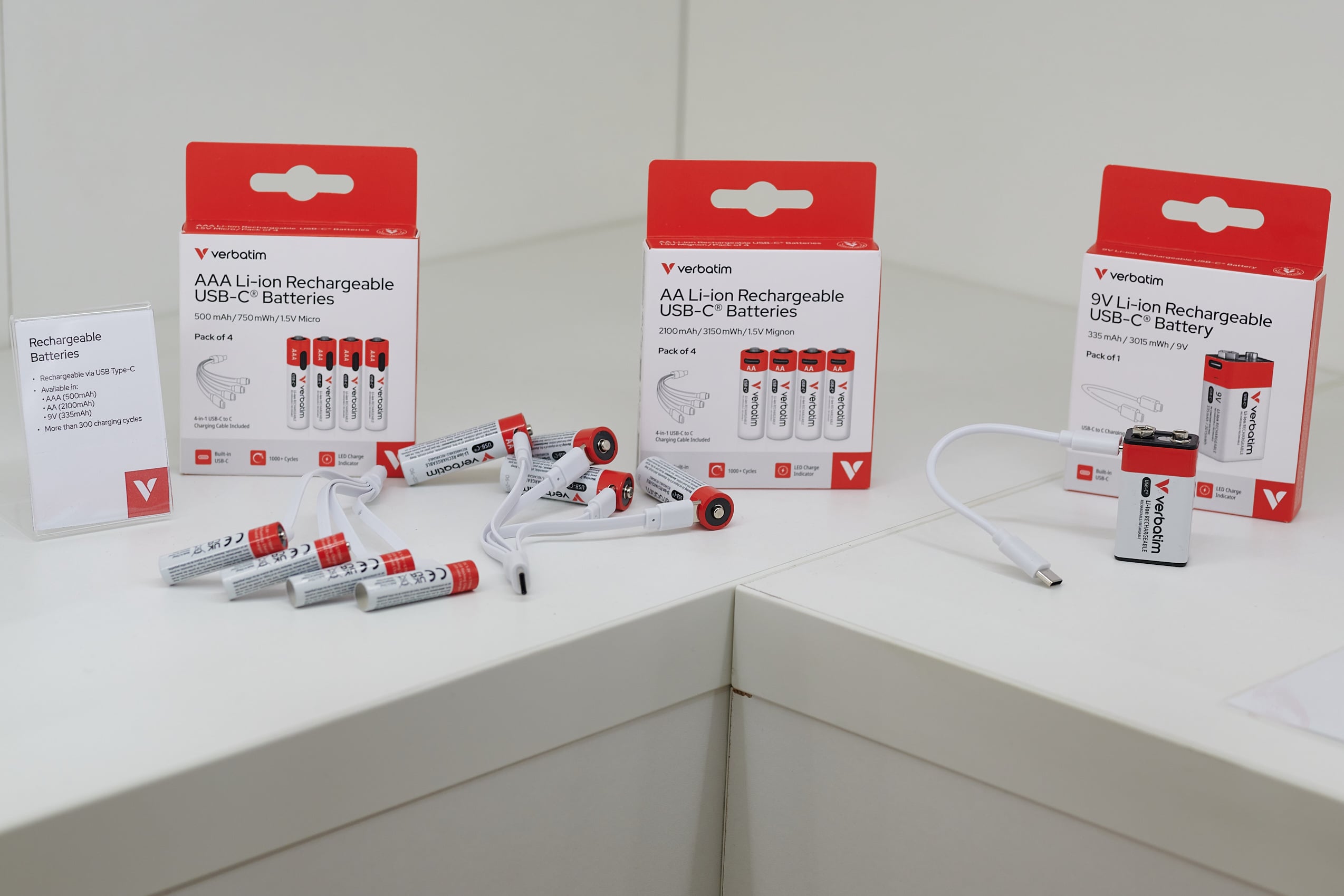
Somewhere in your house is a drawer with loose AA batteries rolling around in it, and you have no idea which ones still work. Verbatim's answer, shown off at IFA in Berlin, is to move the charging port onto the battery itself. Plug the cell into the same cable that charges your phone and wait.
The company brought AA, AAA and 9V lithium-ion cells, all of which charge over USB-C with no dedicated charger involved. The AA and AAA packs come with a multi-connector charging cable so you can top up several at once. The AAA is worth a second look, because its USB-C port runs lengthwise along the cell instead of sitting across the end, which is about the only sane way to fit a port that size on something that skinny.
Why 1.2 volts has always been the problem
Alkaline cells put out 1.5V. Ordinary NiMH rechargeables put out 1.2V. Most gadgets are designed around the alkaline number, so a fully charged NiMH cell reads to them like one that is nearly empty. That is why battery percentage indicators go useless on rechargeables, and why some devices flash a low-battery warning on day one or refuse to work properly at all.
Verbatim's cells are lithium-ion underneath, sitting at a much higher voltage, with a converter inside each one stepping it down and holding a steady 1.5V. The 9V does the same thing to land on 9V. Your gadget sees the voltage it expects, and the fuel gauge stops lying to you.
The catch with a flat line
Holding voltage steady has a cost. A regulated cell runs at full strength right up until the converter gives up, so there is no gradual fade to warn you. Verbatim could not say at the show whether these simulate a discharge curve on the way down or simply hold a fixed voltage until they quit. That answer decides how a camera or a smoke detector behaves in the last few minutes of a charge, and it is a strange thing not to have ready at a trade show.
Independent testing of other brands' USB-C cells backs up the worry. Yoctopuce measured a pair of them holding roughly 1.45V for about eight hours and then dropping sharply, and both delivered well under their rated capacity: about 1,100 to 1,230 mAh against a 1,600 mAh claim. The Eneloop tested alongside them hit its rated number.
The numbers
The AAA is around 500 mAh, rated at 0.75 Wh. The AA is 3.15 Wh. The 9V is 335 mAh, or about 3.0 Wh. Watt-hours are the fairer comparison here, because mAh at 1.2V and mAh at 1.5V are not the same amount of energy.
Put them next to the obvious rival and the result splits. A standard Eneloop AA is 2,000 mAh at 1.2V, roughly 2.4 Wh, so Verbatim's 3.15 Wh AA is ahead on paper. The AAA loses. An Eneloop AAA is 800 mAh at 1.2V, about 0.96 Wh, against Verbatim's 0.75 Wh. Call it a fifth less runtime in exchange for the port.
Not the first to try this
USB-C lithium cells are an established category. Pale Blue has sold them for years, and Acebeam already ships a AAA with the port mounted across the end rather than along the side. What Verbatim brings is a name people recognize from blank discs and flash drives to a shelf that has mostly belonged to brands nobody has heard of.
Which leaves the number that matters, and Verbatim did not give it. No price was announced for any of the three. No cycle-life rating either, which is the spec that tells you whether these are a five-year purchase or a landfill item. Verbatim expects them on sale within a few weeks of the show.
If you own an Xbox controller, a wireless keyboard and a camera flash, and you have made peace with none of them agreeing on how much charge is left, these solve something real. If you already own a shelf of Eneloops and a charger that works, wait for the price. A four-pack near the cost of good NiMH makes the USB-C port a nice bonus. Triple that, and you are buying tiny power banks shaped like batteries.