

Thursday September 24, 2026 10:53 am
Alibaba Says the Zhenwu V900 Is China’s Most Powerful AI Chip. It Won’t Say How Fast.

Posted by Andru Edwards Categories: Corporate News, Artificial Intelligence
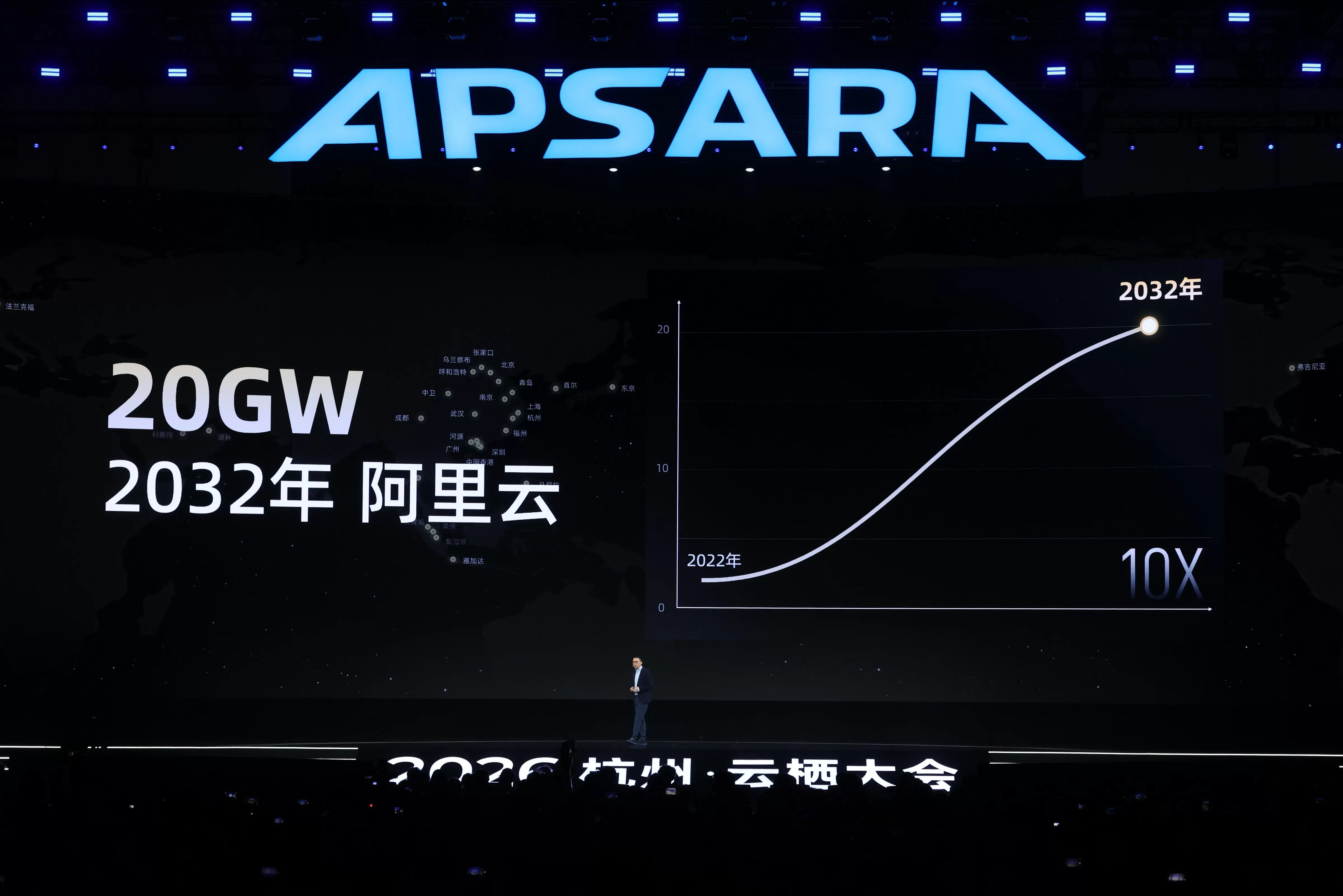
Alibaba's chip unit spent part of its Apsara Conference keynote in Hangzhou this week calling the Zhenwu V900 the most powerful AI chip in China. Then it declined to say how fast it is. No FLOPS figure, no process node, no foundry, no power number. What you get instead is 216GB of memory, 1,200GB/s of inter-chip bandwidth, and native support for FP8 and FP4.
Those are real specs on a real chip, and T-Head has shipped enough silicon that its existing Zhenwu parts serve more than 650 customers, so none of this is vapor. But the line everybody repeated afterward, Alibaba Group CEO Eddie Wu's claim that the V900 delivers "three times the performance of its predecessor, the Zhenwu M890," is a vendor number with nothing underneath it yet. The M890 had 144GB and 800GB/s. Do the division and both of those are exactly 1.5x. Tripling performance off 1.5x on memory and 1.5x on bandwidth means the compute engine has to be doing a great deal more work per clock, and that is the part Alibaba described with an adjective instead of a number.
What Alibaba put on the slide
The V900 comes from T-Head, Alibaba's in-house silicon group, and it steps up from the Zhenwu M890. Disclosed specs: 216GB of memory, 1,200GB/s of chip-to-chip bandwidth, and native FP8 and FP4 support, the low-precision formats that modern training and inference runs lean on. Alibaba Cloud says more than 1,000 V900s can be wired together to behave as a single system, up from 128 chips per supernode on the M890, and that the architecture scales to roughly 500,000 cards in one cluster. Those last two are claims about a cluster nobody has built yet.
The chip did not arrive alone. Alibaba Cloud showed it as one piece of an Apsara supernode stack that also includes an ICN interconnect switch, a Pangu network card and a Zhenyue SSD controller. Wu also put a number on the buildout all of it is meant to fill. Alibaba Cloud is targeting more than 20GW of global data center capacity by 2032, which the keynote slide framed as roughly ten times where it sat in 2022.
The number nobody gave
An AI accelerator has one headline spec, and it is throughput. Petaflops at FP8, petaflops at FP4, whatever precision the vendor prefers to quote. Nvidia leads with it, AMD leads with it, Google and Huawei lead with it. Alibaba skipped it, along with the process node, the foundry and the power draw, which means nobody outside the company can calculate performance per watt or performance per rack.
That is a strange gap for a chip being sold as the best in its country. In China right now the process node is the constrained variable, and Alibaba chose not to name it.
Against Nvidia, on the one axis we have
Memory capacity is the only spec that supports a direct comparison, because it is the only relevant one Alibaba published. 216GB per accelerator puts the V900 above Nvidia's B200 at 192GB and below the B300 at 288GB. Capacity decides how much of a model fits on a single accelerator before you have to split it across the interconnect, and splitting costs you, so 216GB is a genuinely useful number.
It tells you nothing about how quickly the chip works through that memory. Alibaba did not publish HBM bandwidth either, and it did not publish sustained operations per second. A chip with a lot of memory and unremarkable compute is a perfectly real product with a perfectly real use case. It is not automatically the most powerful anything.
Q1 2027 is the part worth watching
Mass production and commercial release are targeted for the first quarter of 2027. Alibaba's own roadmap in May had the V900 landing in Q3 2027. Pulling a chip launch forward two quarters is not something companies do because marketing asked nicely. It happens when demand is loud and the alternative supply is not coming.
US export rules keep Nvidia's H100, A100 and Blackwell parts out of the Chinese market under a presumption of denial, and Beijing blocked H200 imports in January. Every large Chinese AI operation is shopping domestically now whether it wants to or not, which makes a two-quarter pull-in a supply signal more than a performance one. It also makes the date the thing to check first. Chip schedules slip.
The 10 trillion parameter promise
The other headline out of the keynote was model scale. Wu said Alibaba plans to train a model in the 5 to 10 trillion parameter range. Qwen3.8-Max, the current flagship, is around 2.4 trillion. Qwen 4 is in training now, with Qwen 4.5 and Qwen 5 behind it.
Alibaba has not said those models will be trained on V900 silicon. The M890 supernodes already running commercially handle models above 2 trillion parameters, Qwen3.8 and Moonshot's Kimi K3 among them. The chip and the model roadmap shared a stage on the same afternoon, which invites you to connect them. Alibaba did not.
Who this is for
If you run a Chinese AI company that cannot buy Nvidia, you will be evaluating the V900 regardless of what it eventually benchmarks at. T-Head says its existing Zhenwu chips already serve more than 650 customers across autonomous driving, finance, model training, embodied AI, energy and manufacturing, and it has moved to an annual refresh cadence, which happens to be Nvidia's cadence. For everyone else, this is a datapoint on how quickly China's domestic accelerator stack is maturing, and not much more than that until someone runs an independent benchmark on one.
The V900 ships in Q1 2027 if the schedule holds. What to watch for is whether a customer publishes an actual training run with wall-clock numbers, or whether the 3x stays a line from a keynote. Right now, the most powerful AI chip in China is something Alibaba said about a chip nobody outside Alibaba has measured.