

Tuesday September 8, 2026 10:26 pm
The Xiaomi 18 Fold Is 219 Grams, Runs Xiaomi’s Own Chip, and Stays in China

Posted by Andru Edwards Categories: Smartphones, Displays
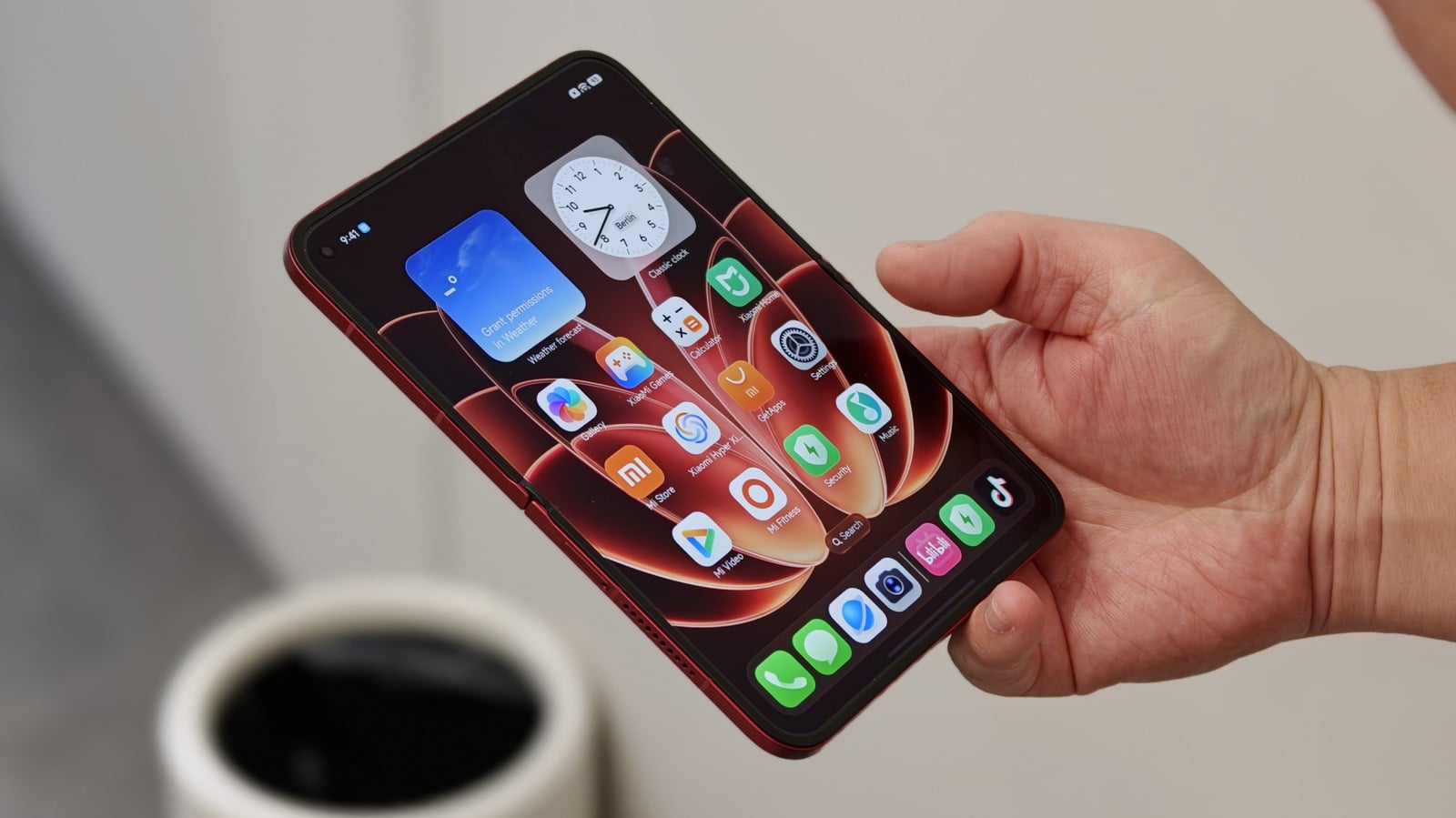
Most book-style foldables open into a shape that is close to square, which is fine for a map and awkward for almost everything else. Xiaomi copied a piece of paper instead. The Xiaomi 18 Fold opens to a 7.58-inch screen with the proportions of an A4 sheet, and closes onto a 5.38-inch cover screen with exactly the same proportions.
It weighs 219 grams, which makes it the lightest foldable Xiaomi has built, and it runs the XRing O3, the 3-nanometer processor Xiaomi designed in-house. The phone went official in China on September 7 and spent this week on the show floor at IFA in Berlin. It goes on sale September 10, one day after Apple's event.
Why both screens are the same rectangle
Fold an A4 sheet in half and you get A5, the same shape at half the size. That is the ratio Xiaomi built to. The inner display runs 2,364 x 1,672 and the cover display runs 1,712 x 1,168, which is one rectangle at two scales. An app that looks right closed looks right open, without the layout scrambling that makes some foldables feel like two phones sharing a hinge.
Both panels are what Xiaomi calls HyperRGB, a full RGB subpixel layout rather than the shared-subpixel arrangement most OLED phones use. You notice it on small text and thin lines, where the edges look cleaner instead of slightly fringed. Peak brightness is 4,000 nits, the number that decides whether you can read the thing outside in direct sun. Refresh runs 1Hz to 120Hz on LTPO, so a static clock face can drop to 1Hz and stop draining the battery.
Xiaomi is making its own flagship chip now
The XRing O3 is built on TSMC's 3nm process, with a 10-core CPU (two Ultra cores, four Premium, four Pro), a 16-core GPU, and support for LPDDR6 memory. Xiaomi puts it 52 percent ahead of the XRing O1 that came before it.
Very few companies design flagship-class phone silicon on a leading-edge node, and Xiaomi has joined them. What nobody outside Xiaomi has yet is an independent benchmark of the O3 in a shipping phone, so the performance figures are the company's own. A peak score and twenty sustained minutes of gaming are two different measurements.
Cameras, battery, and the millimeters
The rear camera is a Leica-branded trio: a 200MP main sensor (1/1.56-inch, f/1.7, stabilized), a 50MP ultrawide, and a 50MP periscope telephoto at 3.5x. The periscope is the hard part of that sentence. Folded, the 18 Fold is 10.68mm thick; open, each half is 5.02mm, and a periscope module has to lie sideways inside that.
The battery is a 6,000mAh silicon-carbon pack, charging at 67W wired and 50W wireless. Silicon-carbon chemistry is the reason a phone this thin can carry a battery that size.
The catch is where you can buy it
This is a China-only launch. Pricing starts at 10,999 yuan for 12GB of RAM and 256GB of storage, then climbs to 11,999 for 512GB, 12,999 for 16GB and 512GB, and 14,999 for 16GB and 1TB. A ceramic edition runs 15,999. Colors are black, white and red.
You will see 10,999 yuan converted to roughly $1,640. That is a currency conversion at this week's rate, not a US price, and there is no US price, because Xiaomi does not sell phones through American carriers. The company has announced no international release and no date for one.
The timing
Apple's event is Wednesday, September 9. A foldable iPhone is widely expected there, and that expectation is still a rumor. Apple has confirmed the date and nothing about the product.
If you are reading this in the US, the 18 Fold is a phone you follow rather than buy. Watch the weight anyway. Xiaomi got a 7.58-inch foldable down to 219 grams with a 6,000mAh battery inside it, and that is the bar Apple's first attempt gets measured against on Wednesday.