

Friday September 4, 2026 2:20 pm
Ugreen Built a Smart Home That Skips the Cloud. The Big One Costs $19,999

Posted by Andru Edwards Categories: Smart Home, Storage, Artificial Intelligence
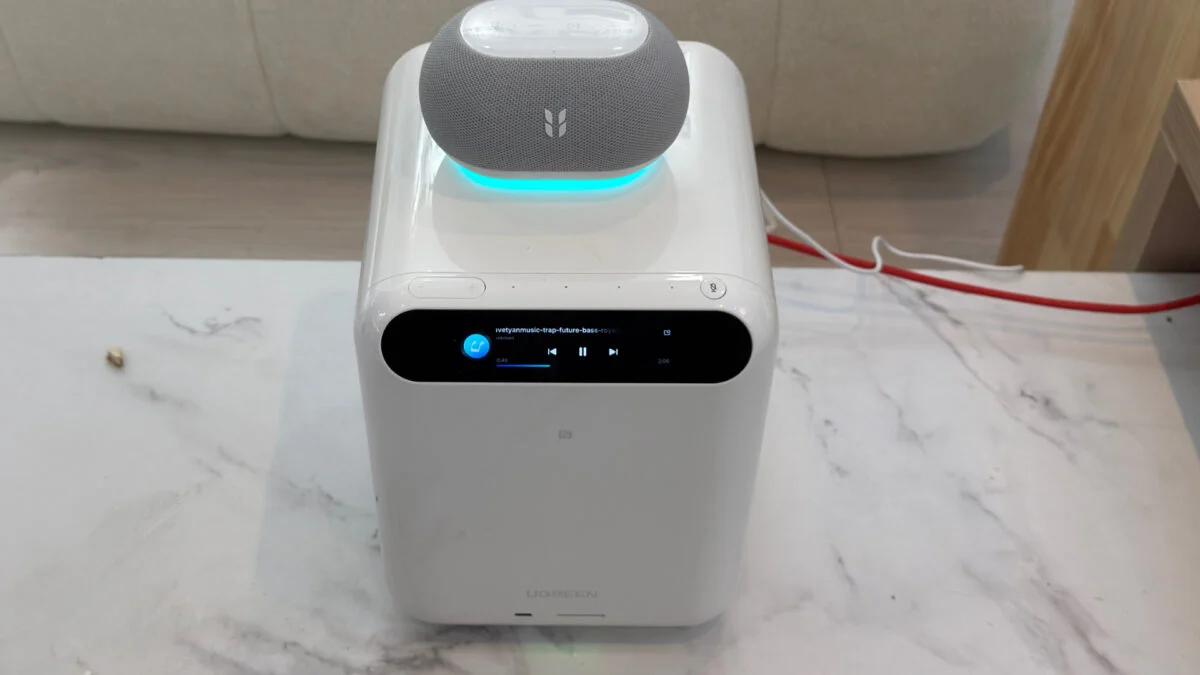
Your security cameras are almost certainly shipping video to somebody else's server right now, and you are probably paying a monthly fee for the privilege. Ugreen showed up at IFA in Berlin with a lineup built on the opposite idea. The box sits in your house, the footage stays on it, and the AI that reads that footage runs on the same machine, with no subscription attached.
There are three of them, and the spread is enormous. The HomeAgent HA100 lists at $1,799, the HA100 Pro at $5,999, and the MasterAgent MA100 at $19,999. Early backers pay roughly half. Nothing ships until late January 2027 at the earliest, and the MA100 not until July of that year.
What running it locally actually gets you
Ugreen's claim is that footage, photo libraries, and device logs live on the hub's own drives, that the AI reading them runs on the hub, and that your cameras keep recording and your automations keep firing when the internet drops. AI features are off by default, the company says. Nothing carries a recurring fee.
The argument holds up for boring reasons rather than paranoid ones. A cloud camera service is a company, and a company can raise its price, move a feature you already use behind a higher tier, get bought, or switch the servers off. Anyone who has owned a smart home gadget for five years has been on the wrong end of at least one of those. A hub sitting in your basement is not subject to a pricing meeting.
Running it locally also means the failure modes are yours now. If the drive dies, last March died with it, and no support line is going to restore a backup you never made. Ugreen is selling you the good half of that trade loudly and leaving you to work out the other half.
Three tiers, and what separates them
The HA100 is the entry point, built on an RK3588 with 16GB of LPDDR5 and 64GB of onboard flash, rated at 26 TOPS. That buys rule-based routines, home control, and a camera feed that can tell a person from a pet from a delivery van. The $5,999 Pro steps up to a CIX chip, 32GB of memory, and 205 TOPS, which Ugreen says is the budget required to read motion and not only objects, and to let you set up automations by talking instead of tapping.
Then there is the MA100. Nvidia Jetson Thor T5000, 128GB of memory, a 256GB NVMe drive, and a claimed 2,070 TFLOPS at sparse FP4. Jetson Thor is robotics silicon. Ugreen has put it in a home-shaped box and priced it accordingly.
All three take your own hard drives through SATA bays, M.2 slots, and an SD card slot. The hub is also the NAS, which is the smartest decision in the whole lineup. The thing analyzing your footage is the thing storing it, so nothing has to leave the house to be useful. It is also why the pitch stretches past cameras into playing your own music library and searching your own backed-up photos by voice.
So who is buying a $20,000 hub?
Ugreen has not described that customer beyond putting the MA100 at the top of its range. Take the early-backer discount and it is still $9,999, which is more than most people have spent on every screen, speaker, and appliance in their house combined. It is also the last product in the lineup to arrive, in late July 2027, nearly a year after Ugreen started collecting deposits.
The HA100 is the one that has to carry the argument, and at the $899 early price it lands somewhere near a few years of camera subscription fees. That is the math Ugreen needs people to do. The MA100 is there to make the rest of the shelf look reasonable, and possibly to give one very specific person the fastest home AI box on the market.
The assistant is the weak link so far
Uliya is Ugreen's voice assistant, and right now it is the thinnest part of the pitch. Gizmodo's hands-on from the show describes an assistant that paused for several seconds before answering, often ignored its own wake phrase, and switched on a speaker when it was asked to turn the lights pink. Demos are demos and the software is more than a year from shipping, but a local-first smart home lives or dies on whether the voice layer works without the cloud there to bail it out.
There is a wrinkle in the local-first story, too. Ugreen says Uliya runs Qwen3 on the hub and can optionally reach out to cloud models including ChatGPT. That is a defensible engineering call, since a small local model will lose to a big remote one on open-ended questions. It does turn "local" into a setting instead of a guarantee, and where the default lands is worth watching. The assistant also has its own hardware, a $99 speaker that early backers get for $69.
Dates, money, and the crowdfunding asterisk
Deposits opened September 3, at $50 to hold a HomeAgent and $200 for the MasterAgent. The Kickstarter proper starts October 27. Shipping is staged, with the HA100 in late January 2027, the Pro in late April, and the MA100 in late July. Ugreen lists the US, Canada, the UK, Australia, Singapore, and most of the EU as destinations. Every price is in dollars, and no separate regional pricing has been announced.
All of which comes with the usual warning. This is a crowdfunding campaign, not a retail launch, so the dates, the discounts, and the feature list stay provisional until hardware is in boxes. Matter works from day one, with Zigbee and Thread listed as coming later. There is no official Home Assistant support, which is a strange gap in a product aimed squarely at people who have already decided not to trust the cloud.
If the $899 HA100 arrives in January doing half of what Ugreen demonstrated in Berlin, it will make the case for local AI far better than the $19,999 machine above it ever will.