

Monday September 7, 2026 7:33 am
TCL Printed a 28-Inch Tri-Fold OLED Monitor That Folds Down to 16 Inches

Posted by Andru Edwards Categories: Displays, Peripherals
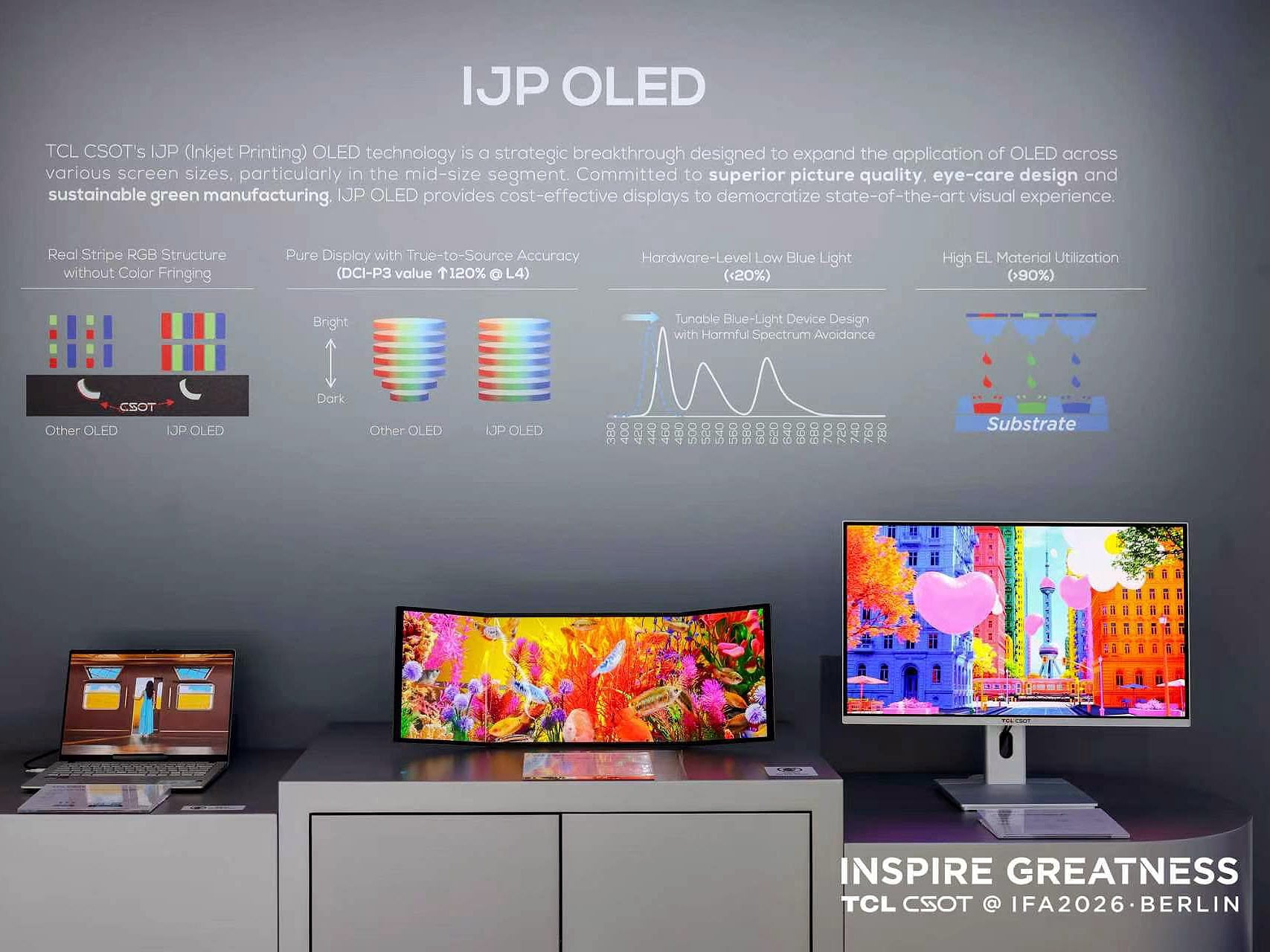
Portable monitors have a size problem. The ones big enough to be useful are a pain to carry, and the ones easy to carry are barely worth unpacking. TCL's display arm brought a possible way out to IFA 2026 in Berlin: a 28-inch ultrawide OLED panel that folds twice and shrinks down to roughly a 16-inch package.
You can't buy it. This is a prototype, and CSOT has been hauling it around the trade show circuit since MWC back in March, with no price and no release date attached. What makes it worth a second look is how the screen was made. Instead of the vacuum evaporation process behind nearly every OLED you own, an inkjet printer laid the glowing material down.
The folding part
The numbers CSOT gives are the ones that matter for something you'd drop in a bag. Unfolded, the panel is 4.48mm thick. The creases have a 1.8mm bend radius, so the layers have to survive a very tight curl at two separate hinges. Do that twice and 28 diagonal inches collapse into 16. TCL CSOT is calling it the first foldable, portable display built with inkjet-printed OLED.
TCL published no resolution, refresh rate, or brightness figure for the tri-fold, which is a decent measure of how early this is. It had numbers ready for the flatter panels sitting next to it: a 27-inch 4K 120Hz printed OLED it says holds 500 nits across the full screen, and a 14-inch 2K notebook panel with an anti-glare film and 99% DCI-P3 coverage.
What inkjet-printed OLED actually means
Nearly every OLED panel in production today is built by evaporation. The organic compounds that make the pixels glow get heated in a vacuum until they turn to vapor, and that vapor settles onto the substrate through a fine metal mask, a stencil that decides where the red, green, and blue subpixels land. It works well, and it wastes a lot of material, because plenty of that vapor ends up on the mask and the chamber walls rather than on the screen.
Inkjet printing does what the name suggests. The OLED material is suspended in a liquid, and a print head squirts it onto the right spots on the panel. Less of it goes to waste, the machines can work a full-size substrate instead of a half-cut one, and more panels come out of each sheet of glass. Research firm Omdia figures a Gen 8.6 substrate yields 66 of the 16.3-inch notebook panels when they're printed, about 10% more than the same sheet manages with a metal mask.
The cost argument follows from that. Omdia published research in May pegging printed OLED notebook panels at roughly 30 to 35% cheaper to manufacture than fine metal mask OLED. "IJP OLEDs can potentially be manufactured at two-thirds the cost of FMM OLEDs," said Charles Annis, chief analyst in Omdia's display research group, who pointed to higher machine productivity and lower capital costs. That 35% figure going around is Omdia's estimate, not a number TCL is promising.
The part that isn't ready
Volume production is the holdup. TCL is still building the T8 Gen 8.6 fab that would make these panels at scale, and OLED-Info's read is that mass production probably won't land until 2028, maybe 2029, since scaling up inkjet printing is harder than scaling the mature evaporation process it's meant to replace. Reports that the plant might be turning out panels by this past July didn't pan out.
Then there's everything a booth demo can't answer: how visible the two creases are in normal use, how the hinges hold up after a few thousand folds, how the panel copes with a bright window behind you. A prototype handled by the people who built it tells you very little about the thing that eventually ships.
The tri-fold is the attention grabber. The bigger prize, if TCL gets its printers working at scale, is ordinary OLED laptops and monitors that cost less than they do today.