

Friday September 25, 2026 9:04 am
Google’s Pixel Watch Can Now Estimate Your Blood Pressure

Posted by Andru Edwards Categories: Wearables, Google, Software
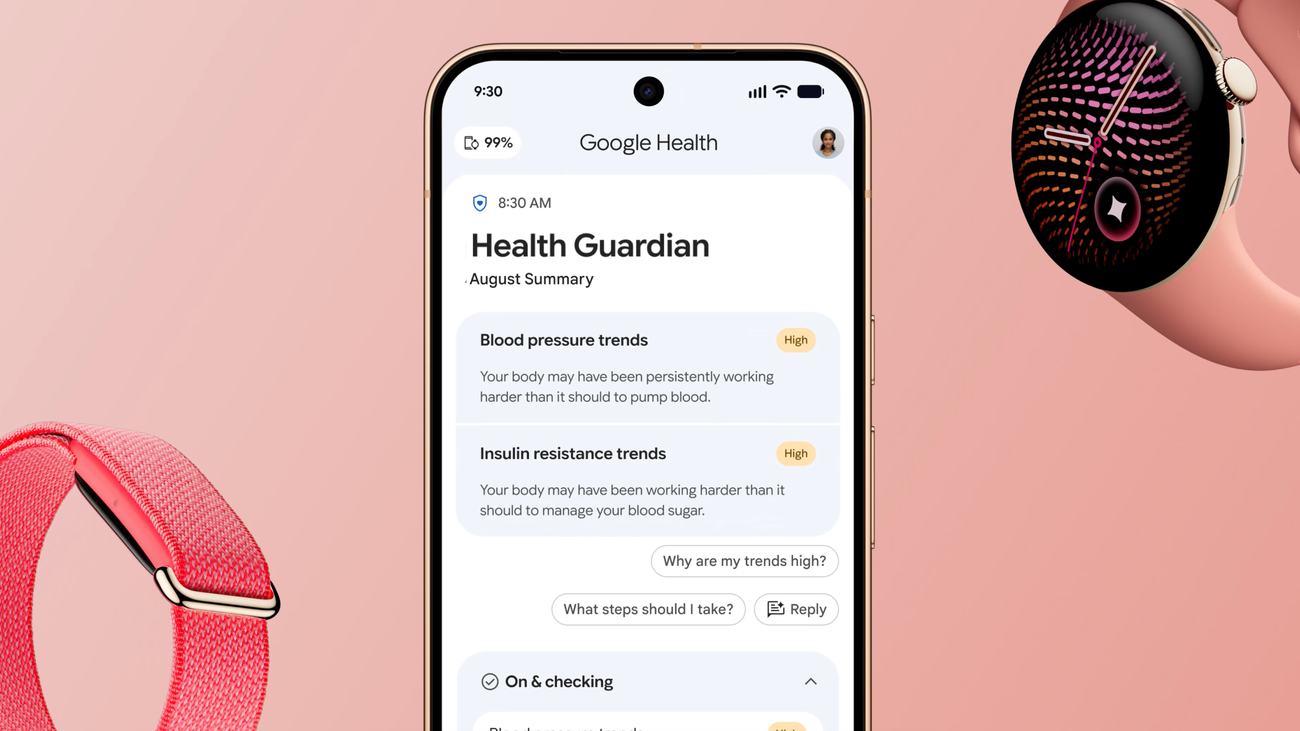
Google's Health Guardian tools start rolling out to the Google Health app this week, which means your Pixel Watch is about to start estimating your blood pressure. It reads your pulse and your motion all month, with no cuff and no calibration, and then tells you whether your numbers have been drifting higher. The first reports land in early October.
That word "estimating" is carrying a lot of weight. Blood pressure trends, insulin resistance trends and sleep breathing quality are all free on the Pixel Watch 3, 4 and 5. Google's own fine print calls all three general wellness features, says they cannot diagnose anything, and says they are not a replacement for the cuff in your bathroom drawer.
What a trend actually tells you
A blood pressure reading is a number at a moment, taken sitting still, on a cuff that squeezes your arm. Google's feature does something different. It watches how your pulse and your movement behave across a month and infers whether the pressure behind them has shifted. It needs at least five consecutive days of data in a week to have anything to say, and it reports on the first of the month.
What you get back is a direction and a sentence. Google's own screenshot of the feature reads: "Your body may have been persistently working harder than it should to pump blood." That is the output. It cannot tell you what your blood pressure is this morning, and Google says directly that you should not use it to adjust medication or a treatment plan. What it is good for is prompting a next step, whether that means digging out a real home monitor or raising it at your next appointment.
Insulin resistance works the same way and is the stranger of the two. Insulin resistance is how efficiently your body pulls energy out of what you eat, and Google calls this a first of its kind on Pixel and Fitbit wearables. It needs a minimum of seven days of data a month and runs on a sensor model pretrained on more than a trillion minutes of data from five million opted-in users. Google says its accuracy was validated against standard clinical blood tests in a paper published in Nature. It is also, by Google's own account, not a prescreener for diabetes, not a real-time glucose reading, and not something to change an insulin dose over.
In Japan and Mexico the same two features ship under different names. Blood pressure trends are Vascular Stress Trends there, and insulin resistance trends are Metabolic Stress Trend. It is the same software answering to a different regulator.
Sleep breathing quality is the third free feature. Each morning it shows how much of the night you spent breathing optimally, and that rolls up into a monthly pattern. Google says it is not a prescreener for sleep apnea.
What Google says about clearance
Google does not claim FDA clearance for any of the three trend features, and under the general wellness label it does not have to. The consequence is that no regulator has reviewed these accuracy claims as a medical device. The clinical validation Google describes is Google's own work. For insulin resistance it was peer reviewed and published, and that is still not a regulator signing off.
The one feature where Google states its status outright is Breathing Emergency Detection, and the wording is blunt: "Breathing Emergency Detection has not been cleared or evaluated by the FDA. This product has been CE marked in the EU."
The ambulance feature, for Europe only
Breathing Emergency Detection is the most consequential thing in this release and the hardest to actually get. It watches for a persistent, critical drop in blood oxygen, the kind caused by severe pneumonia, choking, or an accidental overdose. If you become unresponsive, it calls emergency services and your emergency contacts on its own. It is opt-in, it is limited to the Pixel Watch 4 and 5, and it is available in select European countries and nowhere else.
Google's caveats on this one run long. It may not catch every emergency. It is not intended for pregnant users or people with chronic low oxygen. BMI, sleep disordered breathing, blood flow to the skin, and wrist tattoos can all raise the chance of a false trigger. Emergency calling needs battery and a cellular connection, and Google notes that emergency services may not respond. Turn it on if you are somewhere it works, but do not build a safety plan on top of it.
A flagship that shipped without its own pitch
None of this was on the Pixel Watch 5 when it launched. Google announced Health Guardian on August 12 and is only now starting to switch it on, so anyone who bought the watch on the strength of the health story has spent the interval wearing a promise. It is arriving, which beats the alternative, and the trend features are free and reach back two generations to the Pixel Watch 3. That part is genuinely generous.
The gating is less so. Fitbit Air owners do not get blood pressure and insulin resistance trends until later this year, and when they do, they will need a Google Health Premium subscription. Google Health Coach, the layer that explains what a trend means and suggests what to do about it, sits behind Premium too. So a Pixel Watch owner gets the trend for free and pays for the explanation.
Before you buy anything on the strength of this announcement, work out which of these features your specific watch, in your country, on your subscription tier, will actually switch on. That list is shorter than the announcement sounds. And if what you want is a blood pressure number rather than a blood pressure direction, a home cuff still does something no watch on sale does.