

Tuesday September 1, 2026 8:59 pm
Nvidia’s DLSS 5 Ships September 3, and It Changes What the Artists Drew

Posted by Andru Edwards Categories: PC / Laptop, Video Games, Artificial Intelligence
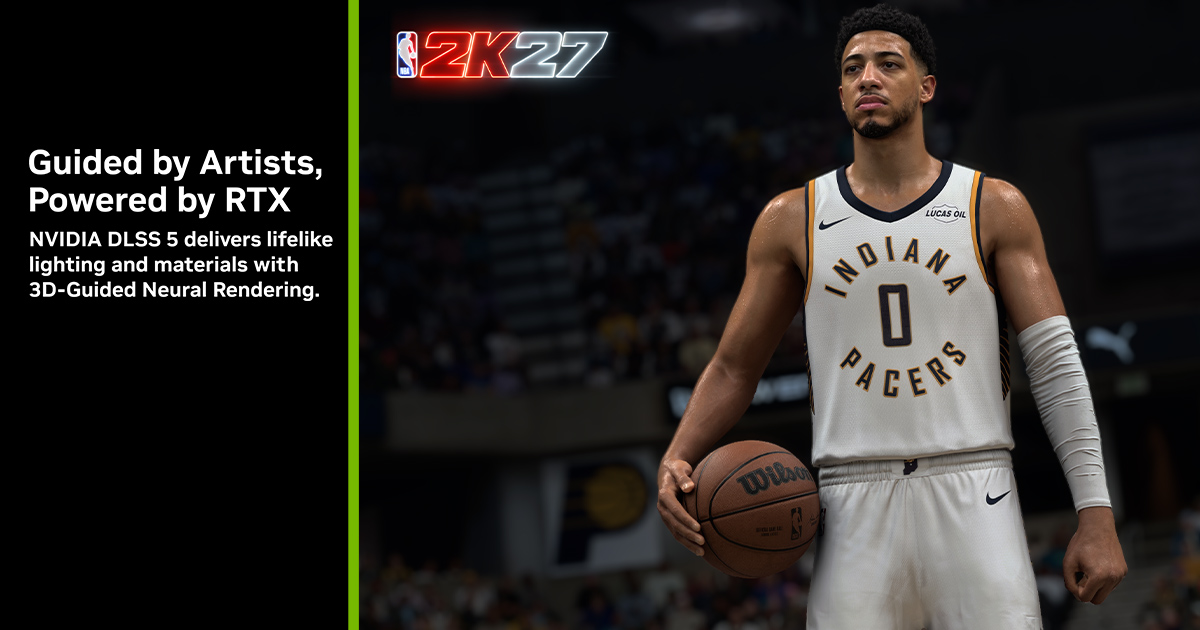
Every version of DLSS so far has been a clever way to draw the picture developers already designed. Render fewer pixels, let the AI fill in the rest, get your frame rate back. DLSS 5 is different. It reaches into the finished frame and adds detail that nobody at the studio put there.
It ships September 3 alongside NBA 2K27, it runs only on RTX 50-series cards, and Nvidia calls it 3D-guided neural rendering. The pitch is that it puts back what real-time budgets force studios to cut: light scattering under skin, light passing through hair and foliage, contact shadows, ambient occlusion. The reception so far has been rough. Early demos built on Resident Evil: Requiem and Starfield drew a pile of complaints about faces that landed square in the uncanny valley, and a leaked build that modders bolted onto older games made the criticism louder.
What the leak showed
The mod came out of an NBA 2K27 build and got pointed at games it was never meant to touch: Control, Skyrim, Grand Theft Auto IV. Control's Jesse Faden came out looking well past her canonical 28. Skyrim characters got what amounts to a photoreal face grafted onto a 15-year-old model, still driven by the same stiff animation. The geometry and the animation underneath never change. Only the surface does, and that gap is what makes it read as wrong. Engadget reported the leaked build also wrecked performance, with Control on an RTX 5070 Ti dropping from 71 fps to 35 fps at 4K. That is an unofficial hack of unreleased code, so grade it accordingly.
Nvidia's answer is determinism
Edward Liu, Nvidia's director of applied deep learning research, argues the model is not inventing anything. "A fruit will stay a fruit," he said. "The same character will still be the same character." The output is derived from the rendered frame, so the same input gives the same result every time, with no dice roll between one playthrough and the next. Liu is also candid about the ceiling here, saying real-time rendering remains "orders and orders of magnitude away from really simulating" reality.
Determinism is a real property, and it answers a real fear. It answers a different question than the one artists are asking. A lighting artist who spent three weeks deciding how much shadow falls under a character's cheekbone was never worried that the shadow would be random. They cared about where it goes. A filter that consistently puts it somewhere else is consistently overruling them.
What actually ships, and who tunes it
Nvidia's own description of the NBA 2K27 build is modest: a bit more depth in faces, slightly more convincing player models and crowd NPCs. The frame rates next to it are the loud part, up to 370 fps at 4K on a 5090 with ray tracing on, up to 260 fps at 1440p on a 5070. A basketball sim is also the friendliest possible test case. Real athletes, real arena lighting, faces the game already scans and matches. Nobody's art direction is on the line in a game that was chasing photorealism to begin with.
Developers do get dials. Nvidia hands them several models with different weights, a Structure Intensity setting for fine detail, a Tone Intensity setting for lighting and color, semantic masking that picks out objects on its own, and engine-level masking to exempt specific objects by hand. Studios wire it in through Nvidia's Streamline SDK or an Unreal Engine 5 plugin. A team that cares can tune this down to a whisper or fence it off from characters entirely. A publisher shipping on a deadline can also leave the defaults where they are.
Should you turn it on
If you have a 50-series card and you are buying NBA 2K27, look at it. It is a toggle, and the useful verdict will come on September 3 from people running the shipped version instead of a modded leak. Nvidia has spent years selling DLSS as free performance, the setting you flip without thinking because it costs you nothing you can see. This one is visible by design. The people best placed to judge whether that counts as an improvement are the ones who drew the original, and by default the driver decides for them.