

Monday August 31, 2026 9:47 am
Hugging Face’s $399 Microduck Ships With Its Training Code on GitHub

Posted by Andru Edwards Categories: Mods / Hacks, Toys, Artificial Intelligence
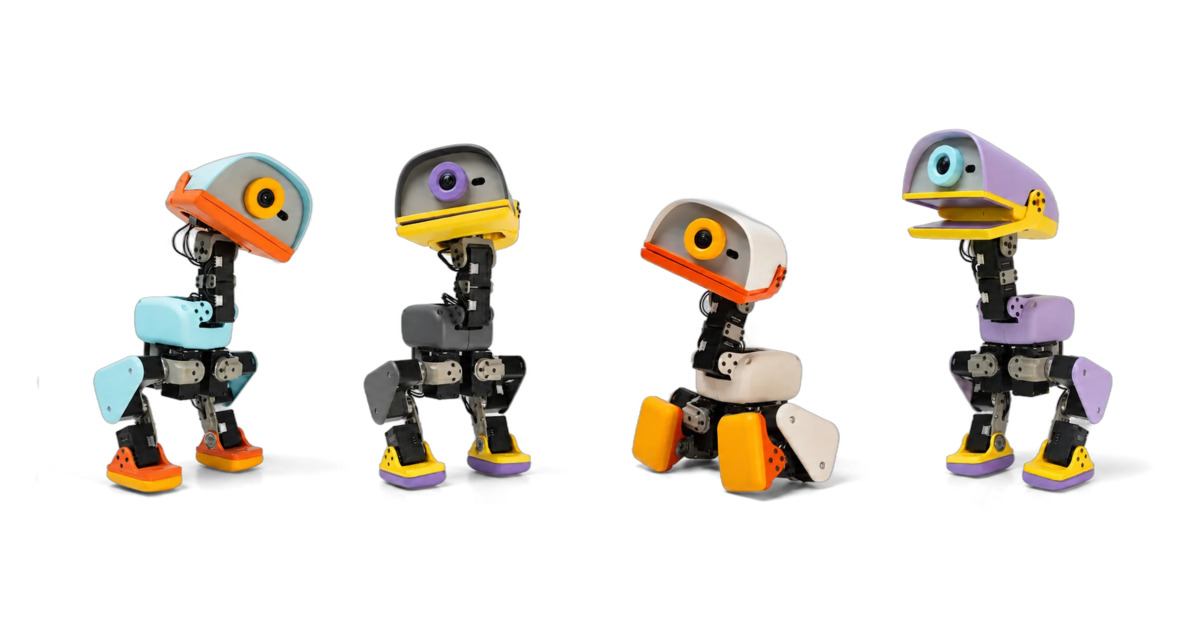
Most robot news arrives as a video. A humanoid folds laundry in a lab you'll never visit, running software you'll never see, and six months later nobody can buy it. Microduck showed up on Thursday as a pre-order page and two GitHub repos.
It's a 25cm bipedal robot duck, it costs $399, and it comes from Pollen Robotics, the French startup Hugging Face bought last year. It walks, sits, crouches, kicks, grabs things with an articulated beak, roller skates, and gets back up after most falls. Seven behaviors ship trained. Every one of them was learned in simulation, and every one of them is yours to retrain.
What $399 gets you
A finished robot, not a kit. Pre-orders opened August 27 at an introductory $399 before tax and shipping (340 euros in the EU), and the box holds the duck, a gamepad, a removable NP-F550 camera battery, and a USB-C cable. Four colors: Cream, Graphite, Lavender, Sky. First deliveries are targeted before Christmas.
The duck stands 25cm tall, measures 14cm across, and weighs under 800 grams, about what a full water bottle weighs. Fifteen motors drive the legs, neck, head and beak. Sensing comes from a front camera, an 8x8 time-of-flight lidar (64 pixels of depth, so think obstacle sense rather than mapping), and two IMUs, one in the body and one in the head. There's a mic and a speaker, but it doesn't talk. It chirps, and each unit gets its own permanent audio identity.
The compute is where the price shows. Inside is a Rockchip RK3566 with four Cortex-A55 cores at 1.8GHz, a Mali-G52 GPU, a 0.8 TOPS NPU, 1GB of RAM and 32GB of eMMC. That's a budget Android box chip, sized for exactly one job: running the 50Hz control policy on the robot. Training happens on your machine, not on the duck. The 2,600mAh battery lasts about an hour, and it's a standard NP-F550 camera cell rather than something proprietary.
What is actually open
The software, under Apache 2.0. The main repo, pollen-robotics/microduck, holds the robot's brain, a set of Rust daemons running the 50Hz loop across fifteen servos, the radios, the camera and the time-of-flight sensor, with signed over-the-air updates and rollback. The second repo, microduck_rl, holds the training side: MuJoCo simulation environments, PPO, domain randomization and ONNX export, covering 13 task variants. The onboard runtime hot-swaps policies behind a shared 61-dimensional observation contract, so a walk policy and a get-up policy are interchangeable files instead of a firmware rewrite.
The hardware is a different story. Pollen has been explicit that the mechanical design shouldn't be called open-source hardware at this point, and the CAD isn't in the repos. So you can rewrite everything the duck thinks and nothing about how it's built.
What you'd actually do with it
The loop looks like this. Train a policy in simulation on a CUDA GPU, which takes an hour or two at 4,096 parallel environments to get a usable gait. Export it to ONNX, push it to the duck, and watch it either walk or faceplant. Then go back to the sim and try again. Falling is the expensive part of legged robotics, which is why Hugging Face CEO Clem Delangue described the design as "made to move, ready to fall."
You can run the simulation before you own the robot. Pollen has a Microduck sandbox up as a Hugging Face Space, so the sim side costs nothing to poke at.
Who should want one
Anyone who wants sim-to-real reinforcement learning on real hardware without a lab budget. Students. Researchers whose grant doesn't stretch to a research biped. Hobbyists who have trained agents in a simulator for years and never had anything physical to deploy them onto. The duck is small enough to fall off a table and cheap enough that you'll let it.
It won't help around the house. It picks up small objects with its beak and follows a laser dot, and that's the extent of it. An hour of battery rules out anything ambient. If you want a machine that does chores, this is the wrong $399.
Pre-orders are open in the US, Canada, the EU, UK, Norway, Switzerland, Japan and South Korea, with more countries promised later. Whether the ducks land before Christmas is the usual pre-order gamble. The code is on GitHub now, and you can read all of it before you spend anything.