

Tuesday September 1, 2026 8:57 pm
Godot Just Got Raytraced Sound, and a Solo Dev Built It

Posted by Andru Edwards Categories: Mods / Hacks, Software, Video Games
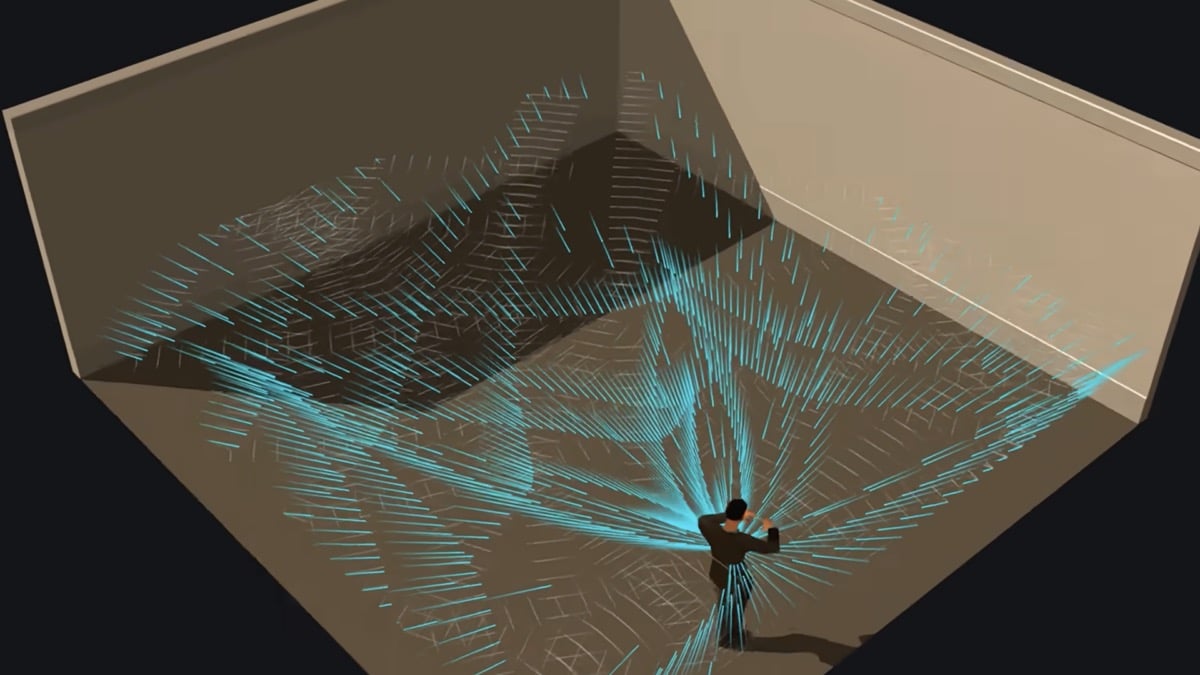
Every time a game makes you feel like you are standing in a concrete stairwell, somebody put that stairwell there by hand. A sound designer drew a box around the space, tagged it with a reverb preset, drew another box around the doorway so footsteps muffle when you round the corner, then did it again for every other room in the level. It works. It is also an enormous amount of tedious labor, and it stops being true the second a player knocks a hole in a wall.
Vercidium, a game developer who has spent the past year posting audio experiments to YouTube, released a plugin for Godot that does the job the other way around. It traces sound the way a renderer traces light. Rays bounce off the real geometry of your level, lose energy to whatever they hit, and what reaches the player is whatever survives the trip. Nobody draws a box around anything.
The rays run backward
Firing rays outward from every sound source in a busy scene would be punishing, so the plugin inverts it. Rays travel out from the player into the world, and any ray that finds its way back to a source contributes to what the player hears. Graphics renderers landed on the same inversion for the same reason.
Surfaces are where it gets fun, because they absorb sound at different rates. The plugin ships with 24 default materials whose absorption values you can tune, and you can define your own. Hang cloth around a room and it goes dead. Line it with concrete and it rings. Reverb stops being a preset somebody picked off a list and becomes a consequence of the room you actually built. Ambient sound works off the same idea, keying on whether rays escape to the sky, so indoors and outdoors sound different without anyone labeling either one.
There are 2D and 3D versions, in both C# and GDScript, so this is not restricted to people running the Mono build.
The accessibility option is the good part
Vercidium built a visualization mode aimed at hearing-impaired players. It flips the rays back around, casting them outward from active sound sources and marking where they land, and the markers can be recolored and reshaped so colorblind players can still read them. A player who cannot hear the footsteps behind them can see where the footsteps are.
Occlusion data has been sitting inside these engines the whole time, doing nothing but making sounds quieter. Turning it into something a player can look at is the kind of idea that normally arrives years later, after somebody files a complaint.
Now the catches
Tracing rays is not free, and the bounce limit being adjustable is a polite way of telling you that you will be tuning it. More bounces buys better acoustics and costs more CPU. A technical preview of the plugin described the work running on CPU background threads over a voxelized version of the scene rather than needing RTX-class hardware, which matters for the low-end machines plenty of Godot games are built for. Nobody has published numbers from a shipping game yet, and I would not trust anyone's numbers until somebody does.
Then there is the word free, which needs an asterisk. The Godot addons are on GitHub under an MIT license, and the Vercidium Audio SDK underneath them is free for non-commercial use with all the core features included. Ship it in anything that earns revenue and you need a paid license: an Indie tier at $300 AUD covering a single game, and a Studio tier priced on request for teams above $500k AUD. Free to learn on and free to prototype with. Not free to sell.
It is also brand new. Wwise and FMOD have a decade of shipped games and angry bug reports behind them, and this has a solo developer and a launch week. If your game goes out next month, keep your reverb zones. If you are early enough that your level geometry is still moving around, this is the moment to try it, since the audio follows the geometry instead of you chasing it.
The download is at vercidium.com, the addon source is on GitHub, and it costs nothing until your game starts making money.