

Friday September 18, 2026 2:37 pm
Laser Strikes on Aircraft Fell 24% This Year, and the FAA Says It Knows Why

Posted by Andru Edwards Categories: Science, Transportation
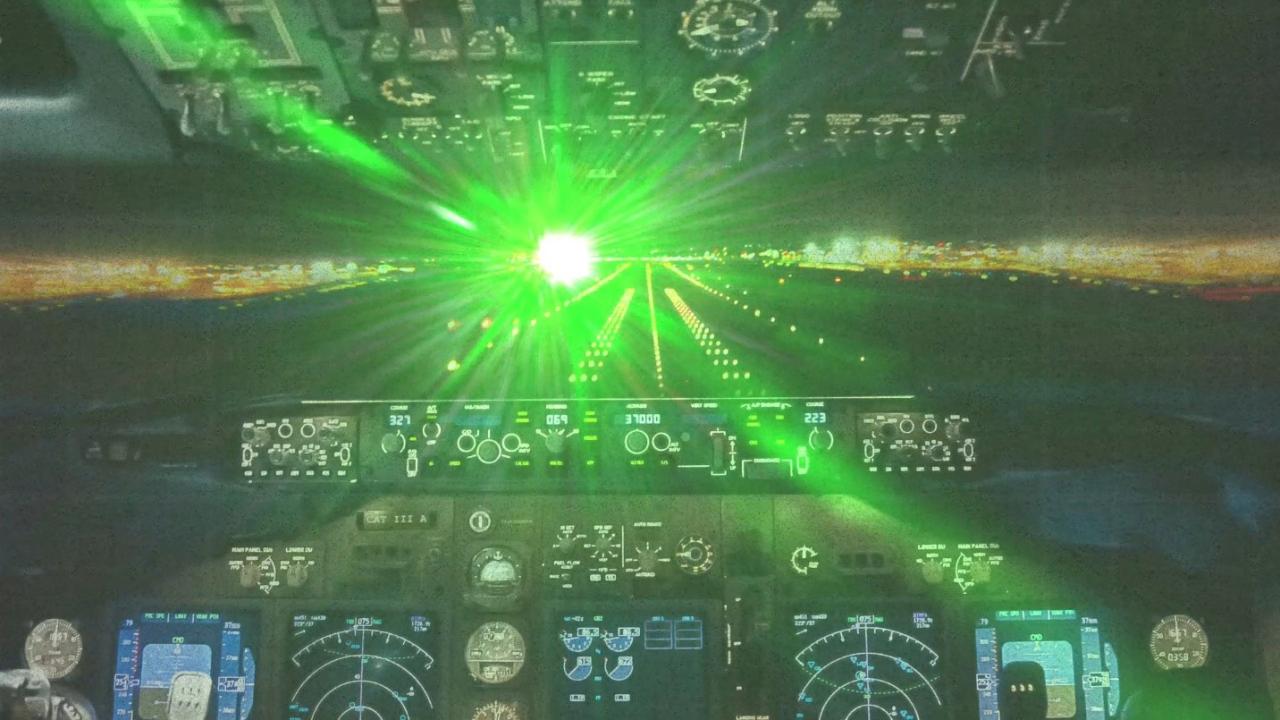
That photo is what a laser strike looks like from the left seat. The whole windscreen washed green, the runway lights behind it barely readable, and a pilot on final approach whose night vision has gone. The FAA published that image. On Thursday it published better news to go with it.
Pilots have reported 4,470 laser strikes to the agency so far in 2026, a 24 percent drop from this time last year and the third annual decline in a row. The all-time high was 13,304 in 2023. Then 12,840 in 2024, then 10,993 in 2025, and now a year running well below that pace.
The FAA says it knows what worked
The FAA named a cause, which agencies often decline to do. Its statement credits the outreach and training it runs with local, state and federal law enforcement, and says that outreach "has resulted in a significant decrease in laser strikes." Back in February, announcing the 2025 numbers, it added a second reason: a strong pilot reporting culture. More reports mean better data on where and when strikes cluster, which tells police which neighborhoods and which hours to work.
That's an agency taking credit for its own program, so weigh it accordingly. It's still a specific claim with the agency's name on it, which beats a shrug at a chart going down.
For January through July, California led on raw volume with 614 reported strikes, followed by Texas at 445, Florida at 232 and Illinois at 224.
Why a pointer matters at 3,000 feet
At arm's length a pointer makes a dot. Thousands of feet away the beam has spread, the air has scattered it, and imperfections in the glass spread it further, which is how you get the photo above instead of a speck on the glareshield. For helicopters the FAA notes it's worse still, because a bubble canopy lets more light in to scatter and reflect around the cabin.
The FAA's pilot safety brochure on laser hazards names three effects. Glare, where you can't see past the light while it's on you. Flash blindness, where the interference persists after the light stops. And afterimage, a reverse-contrast shadow sitting in your field of view that can last several minutes. Getting your vision back, the brochure says, "may take from a few seconds to several minutes." That is a bad window to lose on short final.
The color matters. More than 90 percent of handheld laser illuminations reported to the FAA are green. Green sits around 532 nanometers, close to where a dark-adapted eye is most sensitive, and the FAA's own chart puts it at up to 30 times brighter than red of equal irradiance. Two lasers pulling the same power off the same battery are not the same hazard if one of them is green.
The timing data lines up with the risk. Almost 70 percent of incidents happen between 2,000 and 10,000 feet above ground, which is approach and departure. Roughly 70 percent happen between 7 and 11 p.m.
What the injuries actually look like
Pilots have reported 322 injuries since the FAA started tracking in 2010. The agency is careful about what that means. Permanent eye damage is unlikely, because most exposures are brief, the blink reflex cuts them shorter, and a lot of the energy is lost over the distance involved. What crews report instead is light sensitivity, headaches, eye pain, irritation and an inability to focus, usually clearing within minutes or hours, and in rare cases hanging on for days. The same brochure says no accident has been attributed to laser illumination of a crewmember.
The brochure opens with a scenario it labels fictitious but built from interviews with pilots who have been hit: a 787 captain on final into Boston Logan takes a green beam in the left eye, describes it as feeling punched, hands the aircraft to the first officer, and is diagnosed the next day with accommodative spasm, sluggish pupil response and light sensitivity that took several days to clear. He spent a while wondering whether he'd fly again.
The penalties are already severe
Aiming a laser pointer at an aircraft became a federal crime in 2012 under Section 311 of the FAA Modernization and Reform Act. The FAA can fine you up to $11,000 per violation, and has gone to $30,800 against people with multiple incidents. Federal criminal penalties reach five years in prison and a $250,000 fine, with state and local charges available on top of that.
None of which has ended it. The FAA's own headline calls 4,470 strikes "still too high," and the public data table it updated the same day already lists 5,154 for the year. Three years of decline off a 2023 peak is a real trend and a long way from zero.
Check your holiday projector
The FAA used the same announcement to flag something with no malice behind it at all: holiday laser-light displays, the projectors people stake into the lawn every December. Aimed a few degrees high, those concentrated beams "reach much farther than homeowners may realize," the agency says, and can distract or temporarily blind a pilot the same way a pointer does. If you put one out this year, point it at the house.