
Latest Gear Live Videos
Bleeding Edge TV 522: Toyota Entune Multimedia Overview & Demo

Posted by Andru Edwards Categories: Features, Podcasts, Transportation, Videocasts, Videos,
We visit Toyota Headquarters to bring you a look at Entune, Toyota's in-car multimedia system. Andru Edwards brings you a look and demo of Entune in a few different vehicles. Check out what you get with the different trim levels of Entune:
- Entune Audio: 6.1" - 8" Touchscreen, AM/FM/CD, iPod/USB2.0/AUX, Bluetooth Streaming, Phonebook, Advanced Voice Recognition
- Entune Audio Plus adds: SXM Radio, HD Radio, HD Traffic, Weather
- Entune Premium Audio adds: AM/FM Radio Cache, Navigation, Entune App Suite
- Entune Premium JBL Audio adds JBL speakers and amp for high-quality sound
Don't forget to subscribe to Gear Live's YouTube channel--also, we are giving away awesome perks for our Patreon backers - thanks for your support!
Click to continue reading Bleeding Edge TV 522: Toyota Entune Multimedia Overview & Demo
Advertisement
Justin Bieber Speeding Long Before Arrest?
Posted by Andru Edwards Categories: Music, Legal Issues,
.jpg) Justin Bieber was allegedly speeding hours before he was arrested in Miami last month.
Justin Bieber was allegedly speeding hours before he was arrested in Miami last month.
The 19-year-old star was charged with driving under the influence (DUI), resisting arrest and driving with an invalid license on January 23, but the singer's yellow rented Lamborghini reached 136 MPH at 1.23 a.m., long before he was pulled over by police shortly after 4 a.m.
According to data, obtained by TMZ.com, from the car's built-in GPS tracking system, which recorded its speed and location at all times, the vehicle clocked 108 MPH on the Julia Tuttle Causeway in Miami Beach and accelerated to 136 MPH within a minute while being driven to Set nightclub, where the singer arrived at 2:27 a.m. and partied for an hour before leaving. But the data also shows that Justin was cruising under the speed limit at 27 MPH when he was arrested and accused of drag racing at between 55 and 60 MPH for 15 blocks.
Click to continue reading Justin Bieber Speeding Long Before Arrest?
Bleeding Edge TV 453: Panasonic Lumix ZS20 camera review
Posted by Andru Edwards Categories: Cameras, Features, Podcasts, Product Reviews, Videocasts, Videos,
We give you a look at the Panasonic Lumix ZS20 point-and-shootdigital camera in this episode. The Lumix ZS20 features a 14.1 megapixel sensor, 3-inch touchscreen display, built-in GPS for geotagging images and video, a 3D shooting mode, HDR, 20x optical zoom, and shoots in 1080p at 60 frames per second when dealing with your on-the-go footage (which it stores in AVCHD Progressive format.) We show off the camera, as well as everything else that's included in the box. Want one? You can get the Lumix ZS20 for 17% off on Amazon.
Big thank you to GoToMeeting for sponsoring Bleeding Edge TV. GoToMeeting provides rich, super-simple collaborative virtual meetings - be sure to check them out!
Man discovers international crime ring by using GPS

Posted by Andrey Malskiy Categories: GPS, Transportation, Videos,
Now if you think that high-end crime involving city ports, boats, crime circles, black markets, and Ferraris are things you only see on the big screen, think again.
The owner of a high-end rental car company based on Los Angeles noticed that his Ferrari 458 Italia was sitting still for a few days. Growing suspicious, we got the police involved and the last known location of the car, tracked via GPS.
The police finally caught up with the car in Hong Kong, and found that the Ferrari wasn’t alone in transit. A bunch of high priced vehicles were all heading over to the Asian black market where they can fetch a price twice the value of the car. This still comes out cheaper, since the buyer avoid taxes and fees. More details in the video above as CBS reports on the story.
Read More  | AutoBlog
Bleeding Edge TV 434: Cadillac CUE infotainment system tour
Posted by Andru Edwards Categories: CES, CES 2012, Features, GPS, Podcasts, Transportation, Videocasts, Videos,
In this episode we give you a look at the Cadillac User Experience, also known as Cadillac CUE. This is the new infotainment system that you can expect to find in the upcoming Cadillac XTS and Cadillac SRX as a standard feature, as well as an optional feature on the upcoming Cadillac ATS as well. Cadillac CUE offers a bunch of cool, new features that make driving more fun:
Connectivity: CUE seamlessly connects you to a world of content. Its available 3D GPS navigation system has map-integrated Doppler weather reports. It accesses every contact and song on your Bluetooth-enabled smartphone. It reads text messages aloud and streams Pandora Radio. With downloadable custom apps, its content possibilities are endless. With CUE, you are always connected.
Convenience: CUE starts with a clean, uncluttered design. From there, intuition takes over. Spread your fingers to zoom in closer on a map. Swipe to breeze through your music. Program the homepage to keep your favorites front and center. With fewer buttons and more intelligent controls, CUE also offers natural voice recognition, allowing you to effortlessly place phone calls and play music.
Control: Proximity-sensing technology detects your hand as it approaches the 8-inch LCD touch screen. When an icon is pressed, the screen pulses to acknowledge the command, keeping your eyes safely on the road. Even the gauge cluster is reconfigurable (select models), offering four display layouts that mix vehicle data, such as a speedometer and fuel gauge, with navigation, entertainment and 3-D vehicle image.
Big thank you to GoToMeeting and JackThreads for sponsoring the show - be sure to check them out! GoToMeeting provides rich, super-simple collaborative virtual meetings. As for JackThreads, we've got exclusive invite codes that give you $5 to use towards anything you'd like on the site.
TeleNav shows off HTML5-powered GPS app
Posted by Andru Edwards Categories: GPS, Internet, Software,
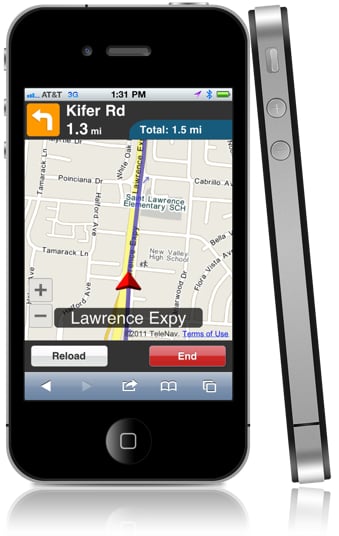
TeleNav, the GPS software company, has unveiled a browser-based HTML5 app that will deliver voice-enabled, turn-by-turn GPS navigation on almost any mobile device—and that other sites can call up with a single line of code.
The concept behind the app is similar to that of Amazon Kindle Cloud Reader: You input the URL and then run TeleNav from within a browser, without installing a native app first. An added benefit: TeleNav can continuously update the service over time whenever it wants, without inconveniencing consumers with periodic software updates.
In an e-mail to us, Mary Beth Lowell, TeleNav's associate director of public relations, confirmed that the HTML5-based app will tap into each device's GPS chip. The combination puts it several leagues ahead of Google Maps, which provides directions without voice prompts, meaning you can also use it in a car while behind the wheel, since you don't have to look at the screen for the next step.
"For example, if I'm in a travel app and I'm looking at my hotel address, I could click on the address and get full voice-guided TBT [turn-by-turn] directions to the hotel," Lowell said. "I wouldn't need to be a TeleNav customer or even download an app."
Click to continue reading TeleNav shows off HTML5-powered GPS app
Black Friday 2011: Sears
Posted by Andru Edwards Categories: Accessories, HDTV, Home Entertainment, Hot Deals, Music, PC / Laptop,

Sears is looking to bring the heat on Black Friday 2011 with a sale that begins at 4:00 am the day after Thanksgiving. We've got the highlights of the sale for you after the break, which include a $99 Kinect sensor, some cheap digital photo frames, and a $30 HD camcorder.
Click to continue reading Black Friday 2011: Sears
Bleeding Edge TV 383: How Ford SYNC Emergency Assistance will use GPS to break language barriers
Posted by Andru Edwards Categories: Full Episodes, Gizmatic, Features, GPS, Podcasts, Product Reviews, Transportation, Videocasts, Videos,
In this episode we give you a look at the upcoming Ford SYNC Emergency Assistance feature, that is able to assist you even in areas where the native language is different than your own. It works by using GPS and cell tower locations to determine where you are in the event of an emergency. If SYNC knows you speak English, but you happen to need help in an area that speaks French, you will be contacted in English on your end, and SYNC will communicate to the responder in French, so that you can get the help you need.
Check out a video for a demo from #ForwardWithFord, which took place in Detroit, MI.
Big thank you to JackThreads for sponsoring the show - be sure to check them out, we've got exclusive invite codes that give you $5 to use towards anything you'd like.
iOS 4.3.3 now available (4.2.8 for Verizon,) fixes location tracking “bug”
Posted by Andru Edwards Categories: Apple, Smartphones, GPS, Software,
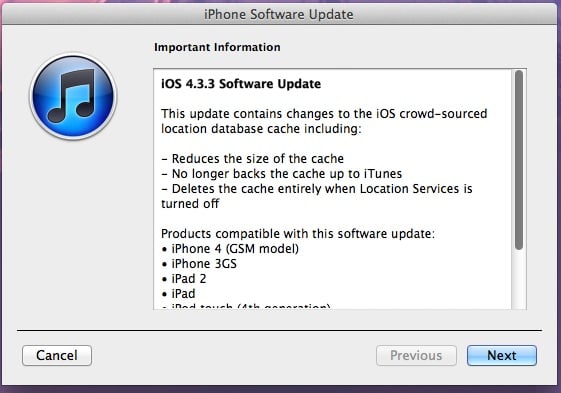
Apple just released iOS 4.3.3, an update aimed to fix the location tracking issue that raised a bunch of concerns over the last couple of weeks. With this update, the consolidated.db database that stores the location data will be reduced in size, and that database will no longer be backed up to iTunes. In addition, if you turn Location Services off, the cache gets deleted entirely. Plug your iPhone in and have iTunes check for the update when you get a chance--jailbreakers, you'll wanna wait until there's a compatible fix.
TomTom apologizes for selling your traffic data to law enforcement
Posted by Andru Edwards Categories: Corporate News, GPS,
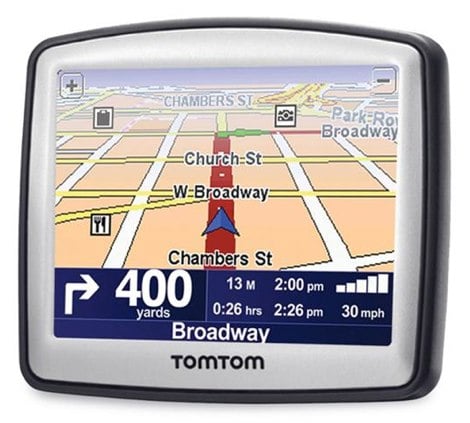
TomTom has apologized for selling user data from personal navigation devices to police.
It wasn't exactly a surprise. When Netherlands-based TomTom reported weak first quarter earnings earlier this year, it said it would try to supplement earnings through certain methods like selling traffic data to governments.
But when Dutch newspaper Algemeen Dagblad revealed that the information was obtained by Dutch police, who used it set targeted speed traps, people got upset.
But TomTom CEO Harold Goddijn said the company only had the best of intentions, because the company believes it "can help make roads safer and less congested."
Click to continue reading TomTom apologizes for selling your traffic data to law enforcement