

Latest Andru Edwards Videos
Watch John Oliver’s brilliant Net Neutrality rant, and then take action

Posted by Andru Edwards Categories: Corporate News, Internet, Videos,
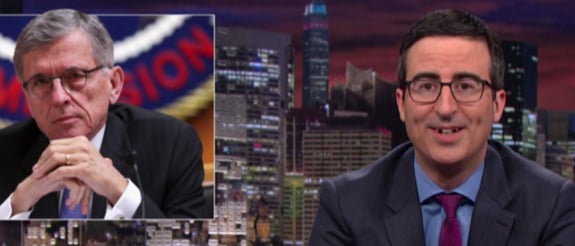
Last week on Last Week Tonight with John Oliver, Oliver did a fantastic segment that lasted over 13 minutes talking about the issue of net neutrality and the work (or, lack thereof) that the FCC is going to address it. He broke it down perfectly and in true John Oliver fashion, touching on all the important points while keeping it light and funny. Then, at the end, Oliver called for the Internet commenter trolls to unite and head over to the FCC Web site to make their voices heard on the net neutrality forum. The result? The FCC site collapsed under the pressure. Seriously, I encourage you to watch the segment, which we've embedded here in this post. After you do, head on over to the FCC Web site and let them know to put a stop to this ridiculousness.
Click to continue reading Watch John Oliver’s brilliant Net Neutrality rant, and then take action
Advertisement
White House responds to petition, says cell phone unlocking should be legalized

Posted by Jason Diaz Categories: Smartphones,
It started as a petition needing only 100,000 signatures requesting that the White House make an official response to the right of cellphone owners to lawfully unlock their cellphones. The Library Of Congress deemed unlocking one's cellphone illegal in October 2012; a ruling that would take affect in the new year. Now, the White House has officially announced that they too agree with the 114K petitioners. It recommends that cellphones be unlocked as long as the customers first meet their carrier's contractual agreement. The White House has even included tablets to the list of devices. Consequently, the Library of Congress has agreed and support the review their policy, which was strongly urged by the FCC.
"The White House agrees with the 114,000+ of you who believe that consumers should be able to unlock their cell phones without risking criminal or other penalties. In fact, we believe the same principle should also apply to tablets, which are increasingly similar to smart phones. And if you have paid for your mobile device, and aren’t bound by a service agreement or other obligation, you should be able to use it on another network. It’s common sense, crucial for protecting consumer choice, and important for ensuring we continue to have the vibrant, competitive wireless market that delivers innovative products and solid service to meet consumers’ needs." - White House Administration
Read More  | White House
AT&T pick up WCS spectrum for LTE expansion

Posted by John Kilhefner Categories: Broadband, Smartphones, Corporate News, Wireless / WiFi,
The airwaves are running out, and you may've noticed it from the data diet your phone company has probably went on, or from the inability to send texts from busy areas in the city.
The FCC has approved the transfer of 608 spectrum licenses to AT&T that cover about 82 percent of the US population. Don't start streaming those 1080p movies from your data plan just yet, as the new spectrum isn't going in effect any time soon. It'll be years before any of us can take advantage of it, we're afraid.
Click to continue reading AT&T pick up WCS spectrum for LTE expansion
Read More | FCC
Help stop AT&T from blocking FaceTime over Cellular from the majority of its customers
Posted by Andru Edwards Categories: Apple, Smartphones, Corporate News, Wireless / WiFi,
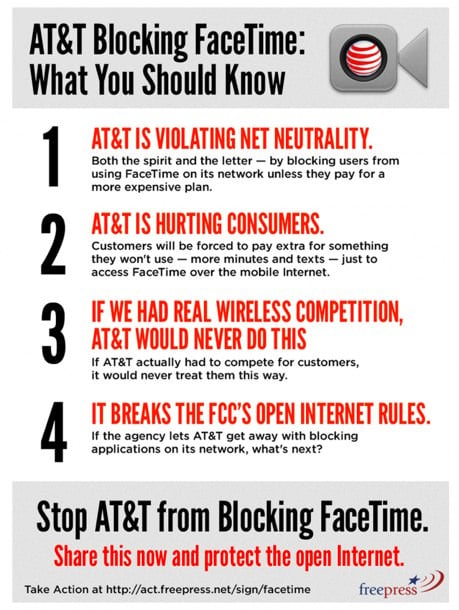
The fine folks over at FreePress are asking the public to take action in an attempt to convince AT&T to reconsiders its position on blocking iOS 6 feature FaceTime over Cellular for all customers unless they switch to a Mobile Share plan. It's an obvious money-grab, a way to encourage its unlimited data users to leave those plans behind, and it shows preferential treatment on how users can use their own data plans. We're signing, and we encourage you to do the same. According to Public Knowledge:
“By blocking FaceTime for many of its customers, AT&T is violating the FCC’s Open Internet rules. These rules state that mobile providers shall not ‘block applications that compete with the provider’s voice or video telephony services.’ Although carriers are permitted to engage in ‘reasonable network management,’ there is no technical reason why one data plan should be able to access FaceTime, and another not. ‘Over-the-top’ communications services like FaceTime are a threat to carriers’ revenue, but they should respond by competing with these services and not by engaging in discriminatory behavior.”
Read More | FreePress
AT&T drops plans to acquire T-Mobile
Posted by Andru Edwards Categories: Smartphones, Corporate News, Wireless / WiFi,
AT&T on Monday announced that it has ended its bid to acquire T-Mobile.
AT&T will incur a pre-tax "breakup fee" of $4 billion in the fourth quarter and will enter into a roaming agreement with T-Mobile's parent company, Deutsche Telekom.
AT&T maintained that the deal would have benefited the U.S. wireless industry. But in recent months, it faced challenges from the Department of Justice and Federal Communications Commission, both of which found that the merger would not be in the public's interest. That opposition, however, does "not change the realities of the U.S. wireless industry," AT&T said.
"AT&T will continue to be aggressive in leading the mobile Internet revolution," Randall Stephenson, AT&T chairman and CEO, said in a statement. "To meet the needs of our customers, we will continue to invest."
Click to continue reading AT&T drops plans to acquire T-Mobile
Here’s how to get free cell phone service
Posted by Andru Edwards Categories: Smartphones, Editorial, Hot Deals,
Yes, you can get a free cell phone with government assistance. If you make very little money, or you're part of other federal programs such as public housing, food stamps, SSI, or Medicaid, you can get a free mobile phone paid for by a fee on everyone else's phone bills.
This program has been around for years. According to the FCC, the government has been subsidizing landlines since 1984; the program, now called LifeLine, added mobile phones in 1997. LifeLine was enhanced in 2005 during the Bush administration, and TracFone's SafeLink, the first purely free LifeLine phone brand, started disbursing free phones in 2008.
"The telecoms haven't done a very good job promoting LifeLine, and the penetration rates have been dismal," said Jose Fuentes, Tracfone's director of government relations. TracFone operates SafeLink.
LifeLine is funded by the Universal Service Fund, which you see as a surcharge on your phone bill. Established by a 1996 law, the USF makes sure that people who live in rural and low-income areas, as well as schools and libraries can get phone service. It doesn't make a distinction between wired and wireless phones; you can get a subsidy for either, but you have to choose one.
Click to continue reading Here’s how to get free cell phone service
FCC filing shows Droid Bionic won’t be a global phone
Posted by Andru Edwards Categories: Smartphones, Handhelds, Rumors,

A draft of the Motorola Droid Bionic's user manual surfaced on the Federal Communications Commission's website, confirming most of the specs that were pulled from Motorola's website last week.
On paper at least, the dual-core smartphone built for Verizon's super-fast LTE network looks like a beast. The filing confirms that it will sport a 4.3-inch qHD display, a GHz TI OMAP 4430 dual-core processor with 1GB of RAM and 32GB of storage, a microSD card slot, an 8-megapixel rear-facing camera, and a VGA front-facing camera. It'll have an HDMI 1.4 output for mirroring the phone's display on a larger screen and support wireless charging. Furthermore, the Bionic will run Android 2.3.4 "Gingerbread."
Click to continue reading FCC filing shows Droid Bionic won’t be a global phone
My letter to the FCC about the AT&T-T-Mobile purchase
Posted by Andru Edwards Categories: Corporate News, Editorial, Wireless / WiFi,
The FCC has opened public comment on the AT&T/T-Mobile merger, and now is the time to make your views known.
I have no idea whether any amount of public outrage will stop this merger, but we might as well try. Checking this morning, I saw that there are already almost 3,000 comments submitted, overwhelmingly opposing the merger.
AT&T set out its justifications for the merger in a 388-page filing with the FCC.
I'm sure that AT&T will soon rally some sort of Astroturf organization to write comments in support of the deal. It's interesting, really: the comments I could find in support of the merger come from groups and trade associations, while the comments against the merger generally come from individual Americans. It's clearly easier to get a lobbying organization in AT&T's corner than it is to get real people in support of this deal.
Click to continue reading My letter to the FCC about the AT&T-T-Mobile purchase
AT&T tells FCC that T-Mobile purchase will boost 4G coverage more than they thought
Posted by Andru Edwards Categories: Broadband, Corporate News, Wireless / WiFi,
AT&T's bid for T-Mobile is now official. The carrier on Thursday filed the necessary paperwork with the Federal Communications Commission, kicking off what will likely be a in-depth review of the proposed merger.
In its filing, AT&T claimed that purchasing T-Mobile will allow it to deploy its 4G LTE network to 97 percent of the U.S. population, up from the 95 percent number it gave last month.
"After conducting a more refined analysis of the combined network, AT&T is increasing the scope of this commitment to 97.3 percent," the carrier said.
AT&T surprised the tech community recently when it announced plans to acquire T-Mobile for $39 billion. AT&T argued that the purchase will help stop the spectrum crunch and spur the companies's deployment of 4G service.
FCC approves net neutrality rules, not good enough

Posted by Patrick Lambert Categories: Corporate News, Internet,
Yesterday, a major decision passed through the FCC as it voted on new rules that will govern the sticky issue of net neutrality in the US. Net neutrality has been a wildly debated subject for years, with everyone from content web sites, Internet providers, wired and wireless networks, and organizations representing end users being all over the map on this subject. Some wanted the government to pass new regulations that would prevent Internet providers from say, slowing down your access to Netflix just because they have their own video site that they want you to use instead. Others argued that if the government does get involved, it could bring much more trouble for the Internet as a whole than the benefit it would add. Others still argued that the free market will handle itself, and that no rules should be added.
So far there had been no real decision either way, with the FCC, the body mandated to govern those things, not having made any clear decision. This changed today as the institution passed a set of rules that help define this. The rules are quite complicated, but suffice it to say pretty much everyone who isn't a big business is unhappy with them. On one side, the new rules do prevent Internet providers from blocking or slowing down access to competing web sites, but it does allow content providers to pay networks to have access to a fast line, bringing their data in priority. Many say the rules are too broad and vague, and fail to address some points. It also leaves a lot of freedoms to wireless providers to, for example, block access to specific apps on your cellphone.
While the debate rages on however, it's important to recognize that these rules simply give formal authority to the federal government to regulate these issues, it doesn't directly change the rules of the game for companies. The new rules will go into effect next year, and could still be blocked by Congress. They are also likely to be challenged in court by any of the parties involved in the discussions.
You can help show your support in the fight for net neutrality at Save the Internet.
Read More | WSJ