

Articles tagged Internet
Latest Andru Edwards Videos
Twitter launches new design

Posted by Andru Edwards Categories: Design, Internet,
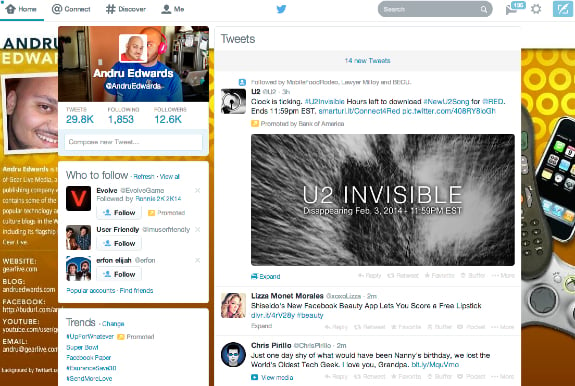
This morning, Twitter deployed its new site redesign, bringing the look and feel of the site up to date with modern design language tendencies. As you browse the site, you'll notice that the font is changed, your profile image and cover photo now appear at the top-left of the screen when perusing your timeline, and flat design elements are now in play. It looks good, and is a big improvement in my mind when compared to the previous design, as subtle as the changes are. It's also good to see the continuance of the flat design look that has been adopted by iOS 7, Facebook, and Windows Phone making its way through more tech companies.
All that said, it isn't enough to pull us away from our beloved Tweetbot, our preferred way of using Twitter. What about you? What do you think of the changes?
Also today, Facebook released it's new Paper app.
Advertisement
Quote of the Day: Chris Pine on Twitter

Posted by Robin Paulson Categories: Movies, Rants, Features,

"No, f--- no. What am I going to tweet about? My sneakers? Or, 'I have 140,000 friends on Facebook.' What does that even mean? I find it to be a waste of time. The Internet is so caustic; just a place where people get to spew nonsense and bullsh--."
- Jack Ryan: Shadow Recruit star Chris Pine explains why he will never join Twitter.
(Make sure to check out our other notable quotes.)
Read More  | People
Miley Cyrus Reveals Why She’s Always Sticking Her Tongue Out
Posted by Andru Edwards Categories: Music, Television, Photos, Features,
.jpg) Miley Cyrus sticks her tongue out in pictures because she doesn't "know how to smile."
Miley Cyrus sticks her tongue out in pictures because she doesn't "know how to smile."
The "Wrecking Ball" hitmaker can't help but pull her signature pose when she's standing in front of cameras because she feels "awkward" just standing there grinning: "I get embarrassed to take pictures. That's actually the truth. I'm so embarrassed, because people are taking pictures of me, and I just don't know how to -- I don't know how to smile, and just be awkward, so I stick my tongue out, because I don't know what else to do."
Meanwhile, the 21-year-old singer, who has hit the headlines this year for her provocative music videos and controversial performances, admits she doesn't search herself on the internet any more because the negative comments ruin her happiness. "I refuse to Google myself. The minute I stopped Googling myself, you don't imagine what a happier person I am," she explained, speaking on Barbara Walters Presents: The 10 Most Fascinating People of 2013.
Eva Mendes’ Mother “Keeps Track” of Her on Google
Posted by Andru Edwards Categories: Movies, Dating, Features,
.jpg) Eva Mendes says her mother "keeps track" of her private life on Google.
Eva Mendes says her mother "keeps track" of her private life on Google.
The 39-year-old actress - who has been in a two-year relationship with Ryan Gosling - explained her mum checks up on her using Internet search engines, but she is trying to discourage it.
"The way my mother keeps track of me is looking me up. I say, 'Please, mother, don't Google me!'" she told next month's Lucky.
Eva admitted her mother was concerned after seeing her "depleted" appearance in The Place Beyond the Pines, but insisted she would "do anything" for her art: "I'll do anything for a role. For [The] Place Beyond the Pines, I exercised a lot. I wanted my character to feel really depleted. My mum didn't understand why I would want to look that way. She's constantly telling me I'm too skinny."
Click to continue reading Eva Mendes’ Mother “Keeps Track” of Her on Google
Bradley Cooper Uses the Internet to Control His Ego
Posted by Andru Edwards Categories: Movies, Features,
.jpg) Bradley Cooper reads negative things about him on the internet to stay grounded. The Place Beyond the Pines star doesn't need to be online long before the things he reads about himself extinguish any ego he may be getting about being a movie star.
Bradley Cooper reads negative things about him on the internet to stay grounded. The Place Beyond the Pines star doesn't need to be online long before the things he reads about himself extinguish any ego he may be getting about being a movie star.
"Maybe if you start feeling a little too big for your britches, hop on the internet and take a look at some message boards for five seconds. It's not something I do often, but if you do, It'll take you right back down. Oh, my, God! First of all, let's be honest: It's incredibly narcissistic to do that and masochistic. You want to feel s***ty about yourself. Boom - it's easy. To me this business [acting] is the ultimate humbling experience. You're constantly dealing with rejection. My journey has not been people kissing my ass."
Bradley also likes his agent to be as realist and brutal with him as necessary. The 38-year-old actor - who was named People magazine's Sexiest Man Alive in 2011 - insists he can only become better at his craft if he listens to criticism.
Click to continue reading Bradley Cooper Uses the Internet to Control His Ego
Yahoo rolls out redesigned homepage

Posted by John Kilhefner Categories: Corporate News, Design, Internet,

Yahoo is rolling out its redesigned homepage today, as promised by CEO Marissa Mayer in a blog post last Wednesday. In it, Mayer wrote that the newly designed landing page will be more "intuitive and personal." The redesign was tested in January, and now will start rolling out to everyone "over the next few days." The new page is more streamlined than ever, giving more prominence to Yahoo's most notable services: email, news, finance and sports. What's more, Yahoo now has a stream in the vein of Twitter. The stream has an infinite stream of news, as well as social features such as the ability to see content recommended by Facebook friends.
Read More | Yahoo
Transporter collaborative data sharing storage device now shipping
Posted by Andru Edwards Categories: Accessories, Corporate News, Internet, Storage,
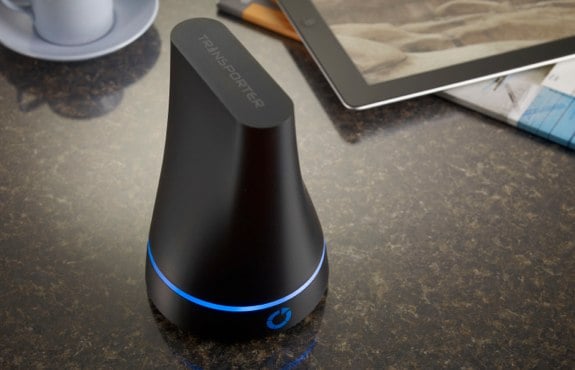
The Transporter is a private data sharing and storage device from the folks at Connected Data, a team comprised of many of the same folks who worked on the Drobo. It's able to communicate with every other Transporter device, anywhere in the world, elimination the need for a third-party cloud storage solution for any files stored. Even more impressive? The Transporter is a Kickstarter project that is actually shipping on time - just 20 days after the end of its massively successful campaign. Compare that to other Kickstarter hardware projects, and you'll see just how impressive this is. You can pick up a Transporter with no drive for $199, a model with a 1 TB drive for $299, or a 2 TB version for $399. Hit the break for a video explaining how it all works.
Click to continue reading Transporter collaborative data sharing storage device now shipping
Read More | Transporter
Google Drive now allows site publishing
Posted by John Kilhefner Categories: Google, Internet,

Google Drive users are now able to publish web content via their Drive storage using a public folder available from any browser. Web content published through Drive will also be able to host JavaScript, so you'll be able to run web apps on your page. Google, being the stickler for simplicity, demands published content remain static, and any outbound links must be addressed in a way that shows up in layman terms.
Read More | Google Apps Developer
Hulk Hogan Sex Tape Leaks Online
Posted by Andru Edwards Categories: Sports, Television, Sex Tapes,
.jpg) Hulk Hogan's sex tape has leaked online.
Hulk Hogan's sex tape has leaked online.
A nearly two-minute clip of the wrestling legend with a mystery brunette, taken from a security camera, has appeared on the internet. In the clip, the 59-year-old grappler - famous for boasting of his "24 inch python" arms - stands by a bed while the woman is spread across it naked. Off camera an unknown man says, "You guys do your thing. I'll be in the office if you need me."
Hulk and the woman - alleged to be Heather Clem, the ex-wife of his best friend, radio DJ Bubba the Love Sponge - can then be seen briefly engaging in sex acts, before Hulk is interrupted and goes to answer his phone as he believes it maybe his son, Nick. They then resume relations and at one point Hulk says, "You got a rubber? I want you to climb on top of me," and the lady duly obliges.
Afterwards, the TNA IMPACT star can be seen getting dressed, but before leaving tells his conquest, "You're a hot commodity."
Click to continue reading Hulk Hogan Sex Tape Leaks Online
Snoop Dogg: ‘The Music Industry Isn’t in Decline’
Posted by Andru Edwards Categories: Gossip, Industry News, Leaks, Hip-Hop & Rap,
.jpg) Snoop Dogg does not think the music industry is in a state of decline. The legendary rapper believes artists in the industry still have ways of controlling their output, and even those new to the scene can find a break if their material is good enough.
Snoop Dogg does not think the music industry is in a state of decline. The legendary rapper believes artists in the industry still have ways of controlling their output, and even those new to the scene can find a break if their material is good enough.
"There's certainly ways to maximize the mistakes that we've made with CDs and the crash and people stealing music: You can still control the material. Now, you can make a video and put it on YouTube and display your skills: record label staffers are sitting in an office all day, every day, looking for it. It's definitely not as bad as people want to make it."
He thinks those who are struggling are doing so because they are stuck in the past and need to see things differently. "A lot of people are still stuck in the 90s. They think the days still exist where you get a lot of money upfront and labels give you two or three videos with big budgets. That ####'s over with," he told The Hollywood Reporter.