
Find Our Latest Video Reviews on YouTube!
If you want to stay on top of all of our video reviews of the latest tech, be sure to check out and subscribe to the Gear Live YouTube channel, hosted by Andru Edwards! It’s free!
Latest Gear Live Videos
Researchers Chart Swimmers with Flow Measurement

Posted by Sheila Franklin Categories: Misc. Tech, Science,

We don’t suppose we are telling any big secrets here by divulging that researchers at Rensselaer Polytechnic Institute developed a technique last year that uses stop motion video to help the Olympic swim teams. Professor Timothy Wei and team’s Digital Particle Image Velocimetry video-based flow measurement helps trainers analyze how much energy is exerted by a swimmer and how their body affects the water. Whew. Check out the video to see how it’s done.
Read More  | RPI
| RPI
Gallery: Researchers Chart Swimmers with Flow Measurement




Advertisement
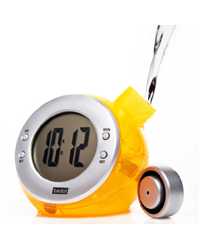 Life doesn’t get much simpler than this. The eco-friendly Water-Powered Clock from Bedol works when electrodes harvest energy from the water. You simply pour salted water into it to get it to run. At a size of 4 x 3 1/2, this timepiece is a step up from a solar-powered one. At the price of $16.00, you get your choice between orange, green, charcoal, or blue. Just remember to carry a receptacle next time you hit the ocean so that you can tell your buds you are saving the planet.
Read More | Bedol
Gallery: Bedol Water-Powered Clock
Asus Vit W1 Laser Mouse With Pulse Rate Sensor
Posted by Sheila Franklin Categories: PC / Laptop, Peripherals, Science, Wireless / WiFi, USB,
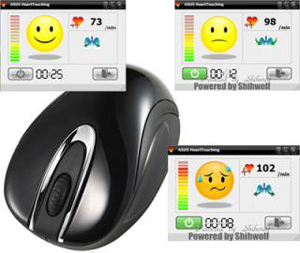 The Asus Vit W1 Laser Mouse does everything else your old mouse can do plus it has a pulse rate sensor that lies beneath its plastic skin. The wireless device has a 30 ft. range, 5 buttons, a mini-USB receiver, and 12 dpi. We don’t know about you, but just knowing that we will be monitored would make us nervous and have an elevated heart rate. Especially if the little happy face starts to frown.
Read More | Everything USB
Gallery: Asus Vit W1 Laser Mouse With Pulse Rate Sensor
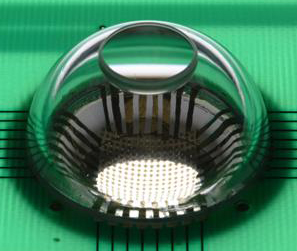 Working under a grant from the National Science Foundation and the U.S. Department of Energy, scientists Yonggang Huang and John Rogers have made an eye-shaped camera that they say could improve digital cameras and enhance imaging. They designed a mesh-like material with tiny squares connected by wires. This prevents breakage that would occur with simple bending. The pair are hoping that someday their eye cam can be used as an artificial retina or bionic eye.
Read More | Reuters
Gallery: Scientists Develop Eye-Shaped Camera
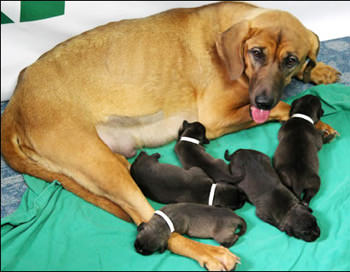
These are the first cloned pets (if you don’t count Dolly and a couple of cows.) A research team from Seoul National University created them from “Booger” who died in 2006. Using somatic cell nuclear transfer from the dog’s ear, the genetic material was injected into eggs, then to the uteri of two dogs. While one of the puppies came by a C section, the other four were delivered naturally. The pups came into the world in Seoul, Korea last Monday.
Read More | Fareast Gizmos
Gallery: Korean Cloned Puppies
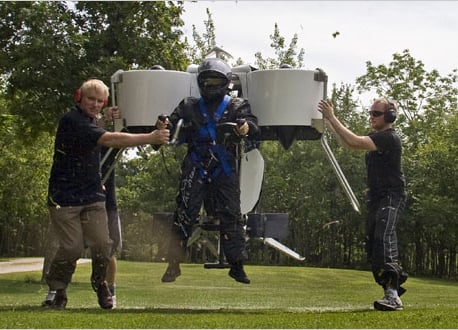
Yesterday, inventor Glenn Martin displayed his jetpack at the EAA AirVenture air show in Oshkosh, Wisconsin. The machine is five feet high, has rotors in two large ducts, a 200-horsepower engine, and rests on 3 legs. It weighs about 250 lbs. and provides 600 lbs. of thrust. Martin has spent 27 years developing his baby and plans to sell them next year for $100,000.00 each if all goes well.
Martin’s wife was the first guinea pig and dubbed it “The Beast.” Fortunately, it also has a parachute for an emergency landing that we figure won’t be needed as the jetpack only flew about 3 feet off the ground. We give the man props for the attempt anyway. Check out the video if you would like to see the launch.
Read More | N Y Times
Gallery: Martin Jetpack Takes Off, Barely
Galactic White Knight Mothership and Spacecrafts
Posted by Sheila Franklin Categories: Corporate News, Science, Transportation,

Richard Branson has partially moved on from inner space travel to the final frontier. The founder of Virgin Airlines and Galactic calls 2008 the “Year of the Spaceship.” His White Knight mothership and spacecrafts were unveiled in Mojave, Ca. The project took about 4 years to complete and will house rich tourists. Designed by Burt Rutan, the project already has involved more than 250 budding astronauts that paid $200,000.00 or gave deposits to be the first to blast off for only 5 minutes about 62 miles above the planet.
Read More | MSNBC
Gallery: Galactic White Knight Mothership and Spacecrafts

Anyone who has seen the Northern Lights knows that they are truly incredible, so it’s almost a bummer that they have found out what they actually are. Scientists at the University of California say they are releases of stored energy that happen when stressed magnetic field lines change into a new shape. The researchers say that this occurs more than 100,000 km away. To catch and study the phenomenon, identical satellites were used to trace the sequence from its initial substorm to the appearance of the colored lights.
Read More | BBC
Gallery: Scientists Demystify Northern Lights
Say goodbye to your old virtual pet. Bio.Genica has created Genpets, which are bioengineered genetic animals. They use Zygote Micro Injection to combine DNA, then put it into the little creepy critters. Each “fetus” has a microchip embedded to control and monitor life functions. It comes packed with its own heart monitor and Fresh Strip to better gauge its state while hibernating. Choose between 1 and 3-year models and 7 personality types that learn and adapt at prices starting at € 350 (~$550.00,) if the video doesn’t leave you feeling like you just don’t want to go there. If you do, we suggest you read their FAQs page and that should do the trick.
Read More | Bio.Genica
Gallery: Bio.Genica Genpets
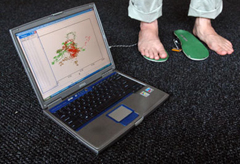 Erez Lieberman, a Harvard-MIT graduate student, has devised the iShoe that will help physicians detect balance problems before falls occur. Given a $50,000.00 grant from the Lunar Ventures Competition to take it past the prototype stage, Lieberman originally developed the shoe for NASA to help them monitor balance problems incurred by astronauts after they return from space. While there he managed to come up with a new system for collecting data and an algorithm to analyze it.
Because his own grandmother had a bad fall a while back, Lieberman realized that the tech could help others. The iSole may also be equipped with an alarm that would let other family members know that a fall has occurred.
Read More | MHT