

Gear Live Comic Book News: Articles Tagged Forgotten Comics
Latest Andru Edwards Videos
Forgotten Comics: Quincy by Ted Shearer

Posted by Tom Mason Categories: Editorials,
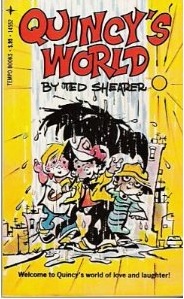 My local newspaper never carried Quincy by Ted Shearer, but I would occasionally see the strip in The Baltimore Sun when visiting family. I liked its “urban Peanuts” vibe, and I really liked Shearer’s artwork.
I recently snagged - thank you library book sale - a long-out-print copy of Quincy’s World, one of the type of once-ubiquitous reprint paperbacks that used to pop up in drug stores and newsstands back in the day. I read through it in one sitting and it was just as good, perhaps even better, than I remembered.
Quincy is a sort of “everykid” in the tradition of other comic strip archetypes like Skippy, Charlie Brown and Tiger. What makes him unique is his optimism, and his light-hearted outlook on his downscale urban setting. Quincy, the strip, is set in a city environment, in a low rent neighborhood populated by rundown buildings, broken fences, and abandoned lots.
Click to continue reading Forgotten Comics: Quincy by Ted Shearer
Advertisement
Forgotten Comics: Howard Chaykin’s The Shadow
.jpg) "He's back…and God help the guilty."
"He's back…and God help the guilty."
My favorite thing to hit at the San Diego Comic Con is the back issue bins – the so-called quarter boxes (usually greatly reduced in price by Sunday) of oddball and overstock comics from the 1980s – now.
At this year's con, there was one dealer in particular who had over a dozen long boxes of comics in nearly alphabetical order, and I and many other well-mannered scavengers thumbed through them all. One of my treasures was the complete 4-issue run of Howard Chaykin's The Shadow from DC Comics (1986).
Coming on the heels of his award-winning run at First Comics with his own American Flagg! Chaykin went over to DC for a revamp of the old 1930s pulp character created by Walter Gibson (aka Maxwell Grant). DC's previous attempt with the character back in the 1970s stayed true to its pulp origins and was unsuccessful despite the involvement of Denny O'Neil, Mike Kaluta and Bernie Wrightson.
By bringing in Chaykin a decade later, it was clear that some things were going to be shaken up and this was not going to be a standard pulp revival. You don't turn to Howard if you want the same old, same old.
Click to continue reading Forgotten Comics: Howard Chaykin’s The Shadow
Forgotten Comics: Iron-Wolf by Howard Chaykin
Posted by Tom Mason Categories: Editorials, DC Comics,
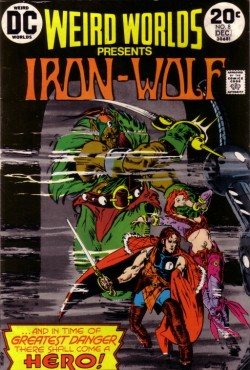 The DC comics of the early 1970s were still fairly stodgy, but newcomers like Howard Chaykin, Mike Kaluta, Bernie Wrightson, Walter Simonson and others were starting to shake things up. I’ve made no secret of my love of Howard Chaykin’s work. He’s a creator who continues to challenge the form, push it, break barriers and twist it around while still having interesting things to say. If for some crazy reason, he took over Bazooka Joe, I’d start buying gum by the case.
In 1972, DC published a comic called Weird Worlds that was a Tarzan tie-in title featuring John Carter of Mars and Pellucidar adaptations. By issue #8, they dropped all the Burroughs-related stuff and went with an original, non-DCU character, Iron-Wolf, created by Chaykin. He plotted it, penciled it and inked it, and Denny O’Neil did the script. The beautiful lettering - seriously, it’s awesome - was by Walter Simonson.
The story is action-packed and a good set-up for a series: Lord Iron-Wolf refuses to turn over his planet’s resources to “allies” of the Empress of Empire Galaktika out of fear it will leave his planet open to attack.
Click to continue reading Forgotten Comics: Iron-Wolf by Howard Chaykin
Forgotten Comics: James Childress and Conchy
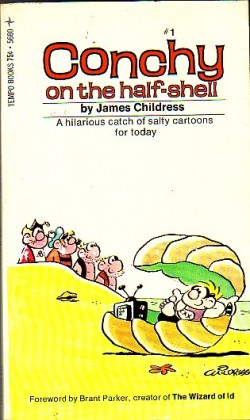 James Childress was a genius. A sharp, funny writer and a terrific cartoonist who deserves to be better known and whose work should be written about more often. After years of trying, he finally developed Conchy, a comic strip about a group of beachcombers that resembled Johnny Hart’s B.C. in certain stylistic bits, but his humor was not as mean-spirited and sitcomish. Childress’ work was infinitely more thoughtful and insightful. Plus he was very funny.
Conchy is the strip that B.C. dreamed of being – funny gags mixed with philosophical thoughts of contemporary life by a cast of characters who lived at the beach. Sharply written with strong characters, its closest comic strip cousin was probably Tumbleweeds by Tom K. Ryan from the same period.
Conchy had an odd run. Childress started out self-syndicating it in 1970. The strip was picked up by Publishers Hall in 1974 who, according to reports, wanted him to move away from his subtle social humor and quiet moments of reflection and go more gag-oriented. He disagreed and left the syndicate in 1976 and went back to self-syndication. Then, because of personal issues not related to the strip (which was gaining papers), he committed suicide in 1977.
Conchy is barely a footnote now. It has almost no presence on the internet and if you didn’t know it, you’d never stumble across it. There were three paperback collections of the strip – all are worth finding. Conchy, Man Of The Now; Conchy On The Half-Shell; and Conchy, Living In Tomorrow’s Past.
Click to continue reading Forgotten Comics: James Childress and Conchy
Forgotten Comics: Howard Chaykin’s Cody Starbuck
Posted by Tom Mason Categories: Reviews, Independent,
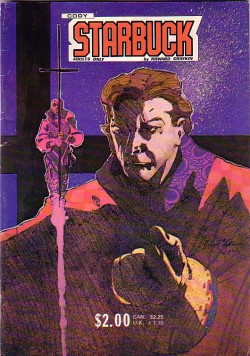 Mike Friedrich was one of the talents of the 1970s and 1980s who changed the comic book business for the better. Dean Mullaney, Phil Seuling, Bud Plant and several others belong on that list as well as several people I’m forgetting. Mike started out as a comic book fan, became a freelance writer for DC and Marvel, transitioned to publishing with his own company (Star*Reach) and later became an agent, turning Star*Reach into an agency representing artists and writers. As a freelancer, he knew well the contracts (and contractual problems) at the major companies. As a publisher he provided an alternative venue for creators to pursue projects DC and Marvel either didn’t want or wouldn’t let the creators own. That may not sound like a big deal, but back in the day if you wanted to tell stories outside of the standard Marvel-DC superhero template, or found yourself on the outs with those two companies, you had almost no alternatives until Star*Reach and Eclipse came along.
When Friedrich became an agent he was able to turn his experience loose on behalf of other creators to negotiate better deals. I’ve read comics Mike wrote, I’ve read comics that he published, and a couple of times I’ve been across the virtual negotiating table from him. [I won’t name names, but at the initial Ultraverse Founders conference in Scottsdale AZ, he quite rightly had his client wait in the hall while he finished negotiating via phone his client’s UV contract. My job at the time was to nod sycophantically and supervise the snack trays for the conference; Dave Olbrich did the actual nuts and bolts negotiating.]
Click to continue reading Forgotten Comics: Howard Chaykin’s Cody Starbuck
FORGOTTEN COMICS: ARMY LAUGHS with Bill Wenzel
Posted by Tom Mason Categories: Editorials,
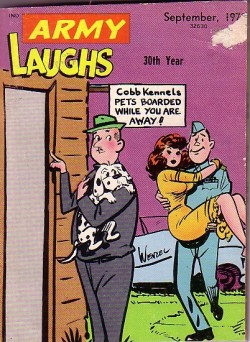
From the early days of cartooning until the market went south in the 1980s, there are a lot of humor publications (and would-be humor publications) that all followed the same basic format: black and white gag cartoons, jokes, odd little articles and features, and the occasional pin-up girl. Many of these publications sported cartoons from cartoonists who would go on to careers at the top cartoon markets like Playboy and The New Yorker, and many of these publications served as dumping grounds by cartoonists who sold off their rejects: selling a dozen cartoons at once that had already made the rounds for $15 each was a quick $180, a way to monetize finished work that no one else wanted. Hey, cartooning is a business, too.
The publications had names like Best Cartoons, Broadway Laughs, Army Fun, Laff Time, Cartoon Carnival, Cartoon Capers and Good Humor and were published by companies like Charlton (at the same time they were publishing their comic books) and Crestwood and Magazine Management. You can guess the target audience by some of the titles.
One of my favorites of that era was the digest-sized Army Laughs (one of many similar titles published by Crestwood), which featured a high-volume of risqué military-based cartoons – almost all of them sexist, along with the usual jokes, text features and teasing pin-up girls with funny captions.
Click to continue reading FORGOTTEN COMICS: ARMY LAUGHS with Bill Wenzel