

Find Our Latest Video Reviews on YouTube!
If you want to stay on top of all of our video reviews of the latest tech, be sure to check out and subscribe to the Gear Live YouTube channel, hosted by Andru Edwards! It’s free!
Latest Gear Live Videos
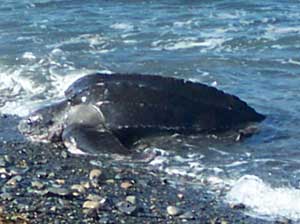
Eleven female leatherback turtles yesterday began participating in what conservationists have called the “Great Turtle Race.” With satellite trackers strapped to their backs, the site hopes to draw attention to their becoming extinct.
Only 58 females arrived at Las Baulas Marine Park arrived this year to lay their eggs, whereas last year there were 124. Their 1,200 mile annual trek from Costa Rica’s Pacific coast to the Galapagos Islands is sponsored by U.S. and Costa Rican businesses and environmental groups. The trip will take about 2 weeks and you can track them online by names such as Windy, Freedom, and Stephanie Colburtle, named after the Comedy Central star.
Read More  | AP
| AP
Gallery: Turtles Document Annual Migration






Advertisement
Brazillian Fair Features the Future of Robotics

Posted by Sheila Franklin Categories: Design, Misc. Tech, Science,
 At the recent Robótica - International Robotics and Artificial Intelligence Fair in São Paulo, attendees were given a glimpse of the future of robotics. A case in point is Mike, who expresses his emotions through his eyes. They turn green for happiness, orange for sadness, and red when he gets angry. The bots are presented by companies such as Comau, Kuka, and Didatech. We just want to know what you actually have to do to the bot to get it angry enough to respond.
Read More | ANBA
Gallery: Brazillian Fair Features the Future of Robotics
Researchers Find Invisibility Possible
Posted by Sheila Franklin Categories: Design, Misc. Tech, Science,
 Engineers at Purdue foresee a time when it will be possible to become “invisible” with the use of a type of wizard’s cloak. Although it is still a concept, the idea is to surround an object with a cone that has metal needles sticking out. The refraction of the cone is then changed so that anything inside seems to disappear. Unfortunately, only one wavelength at a time can be bent, so the person inside must be dressed head-to-toe in a body suit. Think of it as a backwards green screen used in filmmaking. Lead researcher Vladimir Shalaev feels that a working prototype will become available in the next couple of years.
Read More | Seed Magazine
Gallery: Researchers Find Invisibility Possible

If you didn’t grow up in the late 60’s, then perhaps you weren’t aware of the earliest foresight of Kurt Vonnegut. The genius of the man was that he could take the most inane concepts and turn them into science fiction that often became fact. He was the man who decided the meaning of life was a can opener and that the world would come to an end because of ice-nine, a sliver of which would turn any liquid, including bodily fluids, into a frozen disaster.
The novelist’s heroes, such as Kilgore Trout, were sometimes a reflection of himself; his plots concerned the way our society often fails us. His villains were those who could find a way to ruin the planet, just the way many of us are doing in real life. Gear Live will remember you fondly, Mr. Vonnegut, and we know that Bokonon is pointing his thumbed nose up at you in tribute. Also know that while you lived, he admired you for always being busy, busy, busy and for teaching us the same.
Gallery: An Ode to a Vonnegut
 Scientists in the world’s largest particle physics laboratory CERN have developed what is probably our planet’s coldest refrigerator. The LHC (Large Hadron Collider) recently reached -455.8º F (-271ºC,) a temperature that is colder than space.
The device was designed to combine sub-atomic particles to create miniature black holes. Using liquid helium, the LHC uses magnets to guide two beams of protons around a track, causing a collision. The super-cold temperature is needed to allow that current to flow without resistance.
CERN has received some criticism that their mini-black hole could destroy Earth, but experts have stated that the chance of that occuring are “totally miniscule.” We just breathed a sigh of relief at reading that comment as we are not yet ready to reach space by being involuntarily sucked into it.
Read More | CERN via Live Science
Gallery: CERN To Create Mini-Black Holes
GFS Captures Attention of U.S. Military
Posted by Sheila Franklin Categories: Design, Misc. Tech, Science, Transportation,
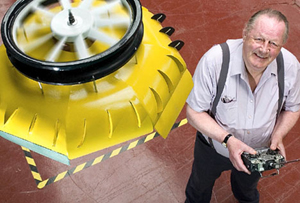
Want the American military to notice your particular talents? You can always use the method of former hovercraft engineer Geoff Hatton. He designed and patented a flying saucer from his workshop in the UK. Dubbed GFS (Geoff’s Flying Saucer), it is powered by an electrically driven propeller that pushes air over its outer surface and features controllable flaps. Although the Ministry of Defense passed on the saucer, which was partially funded by a grant from the Department of Trade and Industry five years ago, the American military believes that it has potential.
“It’s a unique approach which lends itself to a surveillance platform,” said Sal Gomez, of the US Army’s International Co-operative Programs center. “It could be useful in urban areas because if it bumped into walls it could recover.”
We think that it won’t be long before UFO sightings will be the real thing, albeit in a slightly smaller size.
Read More | Daily Mail
Gallery: GFS Captures Attention of U.S. Military
Charles in Space Reaches His Goal
Posted by Sheila Franklin Categories: Misc. Tech, Science, Transportation,
 Way to go, Charles! Our favorite non-professional astronaut Charles Simonyi finally took off over the past weekend and is now on his way to the international space station with two cosmonauts. The U.S. plans to retire its own space shuttle fleet in approximately three years to begin work on the Orion, the next generation of spacecraft. It will be ready to fly around 2015.
This move leaves Russia the chance to become the principle carrier of crews and cargo. Currently, the country builds two Soyuz spacecrafts a year for manned launches and four unmanned Progress cargo ships which can only be utilized once. They are expected to up that figure to 4 Soyuz and 7 Progress vessels by 2010.
Read More | Charles Simonyi via USA Today
Gallery: Charles in Space Reaches His Goal
Ferris Students Win Annual RGMC Award
Posted by Sheila Franklin Categories: Design, Misc. Tech, Science, Toys,
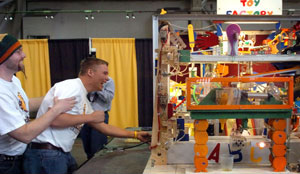
What do engineering students do in their spare time? During the spring they are gearing up for the annual Rube Goldberg Machine Contest at Purdue, which took place last weekend. This year’s problem to solve was to peel an orange, juice it, and pour at least one teaspoon’s worth into a cup. Further rules stated that a minimum of 20 steps must be used and the gadgets must be limited by 5 x 6 x 6-ft. with no explosives, fire, or live animals.
The winning team from Ferris State University managed to stretch the process to 345 steps, breaking Purdue’s previous record of 125 steps. It began with a bell ringing which triggered a line of toy cars that traveled down a chute and up a Jacob’s ladder, causing dominoes to fall and start a train. The vehicle went down a track, causing a hobby horse to drop. After several more steps, a mixture of Diet Coke and Mentos exploded, hit a target, and the orange was squeezed and poured. We didn’t believe it either until we found the video that captured the event. Way to go, Bulldogs.
Read More | Ferris State University via ABC
Gallery: Ferris Students Win Annual RGMC Award
 This week David Johnson, director of the National Weather Service, warned that GPS may be threatened by solar flares. Johnson said that on December 6, 2006, an unexpected flare affected almost every receiver on the lighted side of our planet. To stop this from happening again, current GPS antennas would have to screen the signals out or GPS satellites would have to be replaced with those that will broadcast a stronger signal.
Don’t panic yet. This activity goes in 11-year cycles with the next peak expected in 2011. Let’s hope by then that the scientists that are concerned about the flares will be the ones that come up with a solution.
Read More | CNN
Gallery: Solar Flares May Harm GPS Signals

Professors Carlos Morales and Gabriela Weaver of Purdue have joined forces to teach students chemistry under the disguise of a video game. Players battle aliens and other forces that are trying to destroy the planet by increasing global warming. In each of seven rooms there is a chemistry-based challenge that the students must perform to continue on to the next level. Finish the game and you destroy the aliens’ nuclear reactor.
Morales, who previously worked as a game developer for Xbox, said “I was taken aback by how involved game players become in the game microworlds, how that world inside the game works, how players learn to navigate in that world and continuously strive to improve their performance.”
The game is currently being tested and evaluated by Purdue students, so it will be a while before the rest of us can save the planet.
Read More | Reuters