

Find Our Latest Video Reviews on YouTube!
If you want to stay on top of all of our video reviews of the latest tech, be sure to check out and subscribe to the Gear Live YouTube channel, hosted by Andru Edwards! It’s free!
eBay to Acquire (Ruin) Skype for $4.1 Billion

Posted by Chris Cardinal Categories: Corporate News, Misc. Tech, Software,

eBay has announced (or rather, confirmed) that they are indeed planning to acquire VOIP provider Skype in a deal worth up to $4.1 billion when all is said and done. eBay CEO and President Meg Whitman comments, “Communication is at the heart of community and e-commerce, making Skype a natural fit for eBay,” but I’m more inclined to believe it’s something of a power play made to keep Google or Yahoo from getting there first. Regardless, I’m pretty confident eBay won’t mess with a good thing, and hopefully we’ll see some enhancements and additional features brought into the mix as a result.
Read More  | Skype

 It seems that now that the strike is over, the NHL is getting cuddly with whomever they can. In fact, they have just signed with XM Radio, giving the satellite service the rights to rebroadcast games for the next ten years. The NHL is an addition to XM’s current sports programming of Major League Baseball, Nascar, and PGA golf.
XM Chief Executive Hugh Panero said XM plans to broadcast more than 1,000 games each season featuring all 30 teams in the league. XM will also have a dedicated 24-hour-a-day, seven-day-a-week NHL talk radio channel.
24 hours of NHL talk radio. Um, yay?
Read More | News.com
Advertisement
Video Tombstones

Posted by Kristin Wenzel Categories: Misc. Tech, Mods / Hacks, Portable Audio / Video,
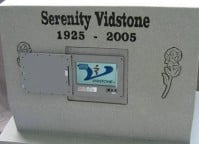 Think traditional grave markers are a little too “low tech?” Well, you’re in luck. A company called VidStone, LLC has just the thing to make your afterlife (or that of a loved one) a little bit more high tech. The company’s “Serenity Panel” features a 5-10 minute, multimedia memorial presentation which can include video, music, speech and text. It is solar powered and features a weatherproof LCD panel to display the montage, at the site of the grave itself, built into the tombstone.
The company produces the presentation from material supplied by the client, and provides a proof for final approval before producing the final product, meant to last and provide the living with a way to remember the deceased. The panel can be attached to just about any grave marker, even in a mausoleum.
Creepy? Cool? You decide.
Read More | Vidstone, LLC
Latest Gear Live Videos
 Why use a triangluar, clunky block of wood to keep the door open when you can do it with much more style? James the Doorman is made of 100% rubber, and holds doors open by sticking his foot underneath it, then holding on for dear life. This little guy will cost you $20 USD, and is available in red or black - despite the green and purple ones shown in the image.
Read More | James the Doorman
Need Disaster Help from FEMA? Hope You’re Using Internet Explorer…
Posted by Kristin Wenzel Categories: Internet, Misc. Tech,
FEMA’s online registration site for victims of Hurricane Katrina is browser specific, throwing another completely unneeded wrench into an already dismal situation for Katrina survivors. Users of other browsers are greeted by this cheerful message upon trying to login:
In order to use this site, you must have JavaScript Enabled and Internet Explorer version 6.
Download it from Microsoft or call 1-800-621-FEMA (3362) to register.
Fantastic. Actually, wait, no. It’s not. It’s simple to fix and sheer laziness on the part of whoever threw the site up. It’s not acceptable, seeing as people may not have access or time to download and install a new browser, for one. Additionally, why make things harder for people who’ve already had it pretty darn hard (and that’s an understatement) to begin with, but that’s just the beginning. In an article from Ars Technica:
Something so minor has become a considerable problem for relief workers, who are attempting to setup as many kiosks as possible for refugees. Workers on the ground have told Ars Technica that they would prefer to avoid setting up Windows XP workstations because they take longer to setup, and even longer to properly patch and configure for use.
XP hardware requirements, while not impressive by today’s standards, rule out using some donated hardware as well. Furthermore, legitimate copies of Windows also cost money, and relief workers are trying to stretch their dollars as far as they can go.
The last thing we really need in a disaster situation is the need for licensing copies of Windows at a high price, software that won’t work on the donated hardware, viruses, security problems, and people waiting for Windows to install (which, on my uber-slick hand-built PC, took three hours and then another hour and a half to patch and update everything). On donated hardware, probably not top-of-the-line brand new stuff like mine… I don’t even want to think of how long it could take.
Nice move, FEMA. Fix it. This is not acceptable.
Read More | ArsTechnica
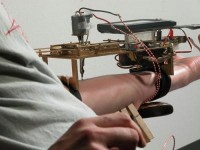 At the Architektur Forum in Linz, a video was being shown of an interesting new project: Kurt the tattoo-robot. Kurt is attached to a person’s arm, then uses a tattoo gun with 4 needles and Chinese tattoo ink to permanently affix a symbol of the
 victim
user’s choice into their skin. This really does seem to fulfill the artists goal of being the ultimate human-machine interface, but for now I personally will keep my beer cold, my tattoos colorful, and my tattoo artists human.
Read More | John Tokyo Land via We Make Money Not Art
The AppleCrate: An Apple II based Parallel Computer
Posted by Kristin Wenzel Categories: Misc. Tech, Mods / Hacks, PC / Laptop,
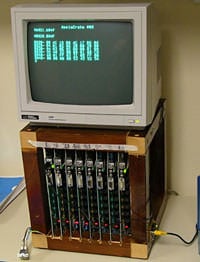 Now this is a stroke of genius. Basically, this guy has taken a number of Apple IIe logic boards and packaged them together, minus the peripherals. He then put them into a wooden crate, and configured everything to run as one unit. Pretty impressive! The site is a bit technical, but it’s very fascinating if you’re into retro tech and innovative things people can do with it.
Read More | The AppleCrate Webpage
Chad Dyner, Inventor of Heliodisplay Interviewed

Posted by Andru Edwards Categories: Misc. Tech, Peripherals,
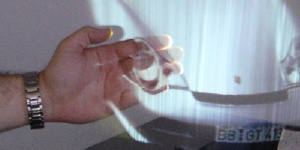 The Heliodisplay is an awesome interactive tactile 3D display that projects images in midair that one can “touch”, causing the objects to react. OhGizmo secured an interview with the inventor of this technology, Chad Dyner.
Okay, so let’s turn to the technology. You say it will accept any video source, be it DVD, TV or computer. So, how exactly does the unit interact with a computer?
It’s essentially plug and play. Now, I realised early on that if we were to bring into the world a disruptive technology such as this one, we were going to have to take incremental steps. You have to understand first of all, that the infrastructure in the world right now is built for two dimensional data. So then, as soon as you say you have a display for two dimensional data, then you get different protocols for displaying this data: NTSC, PAL, VGA on the computer and different types of video signals that can be received into our system.
Read on for the entire interview.
Read More | OhGizmo!
Philips Announces Readius Rollable Display Technology

Posted by Sparky Categories: Handhelds, Misc. Tech,
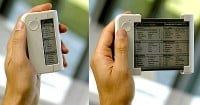 Philips has announced that they will be demonstrating a new roll out electronic display at the IFA consumer electronics expo in Berlin during the first week of September. The Readius “mobile e-reader” features an e-paper based 320x240 5” roll up display. The compact unit can roll up into a 100x60x20mm rectangular prism and promises to revolutionize the e-reader and portable display market. Prototype devices like the Readius promise to change the way we look at PDA’s and laptop display technology and could create a new wave of phones and PDA’s with large screens and pocket-friendly sizes.
Read More | EETimes
As of now, the only definitive way to diagnose Alzheimer’s disease is through an autopsy, but new technology from Aspect Medical Systems is helping to change that. The procedure, which has not yet been approved by the FDA, changes data received through an EEG (electroencephalogram) into a number between 0 to 100, measuring the amount of electrical brain activity. This technology is currently in place in operating rooms where it is used to monitor patients during surgery, but once in place for diagnosing Alzheimer’s could possibly help doctors understand the disease better, leading to earlier diagnoses and maybe even finding a cure sooner than expected.
Read More | Wired