
Find Our Latest Video Reviews on YouTube!
If you want to stay on top of all of our video reviews of the latest tech, be sure to check out and subscribe to the Gear Live YouTube channel, hosted by Andru Edwards! It’s free!
So, let’s be honest - we have all heard of RFID technology by now. To further your education, Spychips is a site dedicated to informing the masses against the possible dangers that exist with this new technology. RFID has infiltrated everyday life, unbeknownst to most. Stores like Wal-Mart use RFID for things like inventory management, and as an anti-theft device. Some of the things that Spychips.com reports on are a bit one sided, but its interesting to see how this technology could be potentially damaging to our privacy. If you do not look out for your civil liberties, and privacy, no one else will.
Read More  | SpyChips
Bill Gates Critiques One Laptop Per Child
Posted by Jared Hislop Categories: Microsoft, Misc. Tech, PC / Laptop,
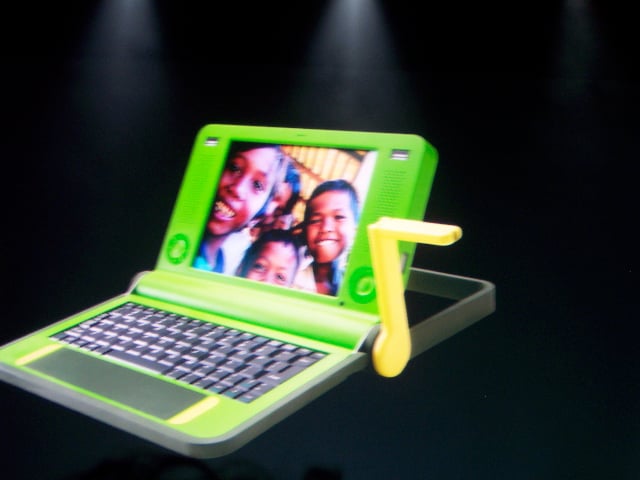
By now most people have heard about MIT’s noble effort to bring technology to third world countries by designing a $100 laptop. Google’s founder, Larry Page, said that Google would back MIT’s project. Bill Gates publicly critiqued the $100 laptop, saying, “The last thing you want to do for a shared use computer is have it be something without a disk…and with a tiny little screen.” Gates went on to say, “If you are going to go have people share the computer, get a broadband connection and have somebody there who can help support the user, geez, get a decent computer where you can actually read the text and you’re not sitting there cranking the thing while you’re trying to type.” Prior to the critique Gates was promoting Microsoft’s new “ultra-mobile computer” which is expected to cost between $599 and $999. What is funny is the $100 dollar laptop program is called One Laptop per Child, or OLPC. These laptops are not being given to American families to close the digital divide here; they are intended to assist children in third world countries that lack the support infrastructures that many of the things Bill Gates is interested in offering require.
Read More | CNN
Advertisement
The Disco Bar Is Complete!
Posted by John Goulden Categories: Home Entertainment, Smart Home, Misc. Tech,
This is one of those things that just has to be seen to be appreciated. If you remember the MIT project where a dance floor was made using 1,500+ LEDs, way too much cabling, and a series of controller boards, then think of this as a scaled down version. Spending approximately $1000, David Worden has cobbled together one of the coolest looking bars around, utilizing 128 RGB LEDs, 250’ of cable, and other assorted paraphernalia. Essentially bringing the visualizations from Winamp to life, the Disco Bar can display a myriad of colors and patterns. Don’t take our word for it though - watch it for yourself!
Read More | The Disco Bar via digg
Latest Gear Live Videos
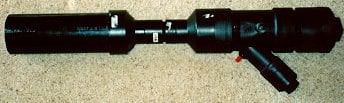
First spud guns, and now the Toilet Paper Cannon. Essentially a glorified spud gun, the homemade contraption launches rolls of toilet paper gracefully through the air. Unlike potatoes, rolls of toilet paper have this rather inconvenient hole (well, inconvenient for use as a projectile anyway) right through their centers. This necessitates the use of wadding to ensure successful launches, but should not in any way impede your participation in TP’ing your neighbors house. Not that we would condone such a thoughtless act. Nope, not us . . . uh-uh, no way . . . well . . . just don’t get caught okay?
Plans are available for approximately $10 USD.
Read More | Xinventions via The Red Ferret
Saved by the Cell - Ringtone Foils Kidnap Attempt

Posted by Kristin Wenzel Categories: Smartphones, Misc. Tech,
 On March 8th, a 12 year old girl was walking home from school on a rural road near Yelm, WA when she was blindfolded, bound and dragged into the woods. The kidnapper might have gotten away with it, too, if it wasn’t for his cell phone. When it rang, the girl recognized her assailant’s unique ringtone and identified him, causing him to run off. She freed herself and went to authorities — the would-be kidnapper is being held on $250,000 bail with a trial scheduled in May. That’ll make you think twice about picking out that ultra-unique ringtone if you are considering a life of crime…
Read More | KOMO News

 The Card Beeper is a simple sheath one would use to protect their credit card. Whenever the card is removed from the Card Beeper, it gives an audible alert at 20-second intervals. Nice for when you forget your card at the mall or when picking up grub at the drive through - not so nice when the cashier is simply holding on to your card to check your signature, and your Card Beeper is screeching in agony. The unit also has an integrated money clip, eliminating the need for a wallet. You can pick one up for $26 USD.
Read More | Sehin-World via Gizmodo
 As we all know, most of what we see in those television infomercials is complete garbage. TVTopTen is a site that aims to pull the wool fromover your eyes, offering the “best” of As Seen On TV products. The site offers reviews on the products, allows customers to post their own reviews, and even offers two-minute clips of the television spots that the products were featured in.
Read More | TVTopTen
MIT $100 Laptop Program Features Innovative Design for the World
Posted by Kristin Wenzel Categories: Design, Google, Misc. Tech, PC / Laptop,
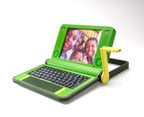
The One Laptop Per Child program was started at MIT and features truly innovative and inexpensive designs, meant to make technology accessible to everyone, and put laptops in the hands of children and communities in developing countries, and rural areas all over the world. The program, backed by Red Hat and Google, would make use of bleeding edge innovations in the technology world, including wireless broadband, DVD capability, and flash memory instead of a hard drive. And, it’s electricity-optional, since it charges with a manual crank, not unlike some emergency flashlights and similar items.
The proposed $100 machine will be a Linux-based, with a dual-mode display—both a full-color, transmissive DVD mode, and a second display option that is black and white reflective and sunlight-readable at 3× the resolution. The laptop will have a 500MHz processor and 128MB of DRAM, with 500MB of Flash memory; it will not have a hard disk, but it will have four USB ports. The laptops will have wireless broadband that, among other things, allows them to work as a mesh network; each laptop will be able to talk to its nearest neighbors, creating an ad hoc, local area network. The laptops will use innovative power (including wind-up) and will be able to do most everything except store huge amounts of data.
This project should be one to watch - it’s great to see technology being put to a use that can contribute to the greater good.
Read More | One Laptop Per Child
Scientists Create Superstrong Artificial Muscles
Posted by Kristin Wenzel Categories: Misc. Tech, Science,
Life imitating sci-fi: University of Texas at Dallas nanotechnologists have created super strong artificial muscles, capable of superhuman feats.
University of Texas at Dallas nanotechnologists have made alcohol- and hydrogen-powered artificial muscles that are 100 times stronger than natural muscles, able to do 100 times greater work per cycle and produce, at reduced strengths, larger contractions than natural muscles.
The buff synthetic muscles could be used in many situations, including autonomous robotics. The muscles, like real muscles, convert chemical fuel to mechanical energy, getting rid of the need for batteries or wired power.
Read More | Physics Org
 Astronauts working at the International Space Station depend on their space suits to keep them alive, but some innovators in Europe are looking to adapt the technology for activities closer to home. Firefighters, industrial workers and other people subjected to extreme temperatures could benefit from the built-in cooling and protective systems integrated into a space suit.
“The main goal is to keep the temperature and humidity levels inside [work] suits at a comfortable level when operating in harsh environments,” Stefano Carosio, Safe&Cool project manager for ESA at the Italian firm D’Appolonia, told SPACE.com. “We used in particular the concept of cooling vests worn by astronauts for thermal management.”
Part of the appeal of the suit is the ability to not only keep the wearer cool and comfortable, but to manage humidity and keep the wearer from losing concentration or ability to perform during strenuous tasks in extreme conditions.
Read More | Space.com